
In a world where the demands of healthcare are rapidly advancing, custom healthcare software development has become a cornerstone for achieving operational excellence and patient care enhancement. The introduction of bespoke applications tailored to the nuanced requirements of the medical sector signifies a transformative leap forward. With an intrinsic focus on personalization and efficiency, tailored medical software is redefining the way healthcare providers engage with technology to deliver exemplary services.
Embracing custom software solutions means embarking on a journey of innovation where each feature and functionality is carefully woven into a fabric that respects the delicate nature of patient data and clinical workflows. This approach is not just about creating software; it’s about sculpting digital experiences that resonate with the users’ intrinsic needs — whether they are healthcare professionals, patients, or administrative staff.
Key Takeaways
- Custom healthcare solutions provide the agility needed to navigate regulatory changes and ensure compliance.
- Bespoke software enhances patient care through improved speed and accuracy in data management.
- Tailored applications offer a seamless user experience, fine-tuned for specific healthcare settings.
- Automating workflows within custom software reduces the administrative burden on healthcare workers.
- Adaptation to new healthcare standards can be readily achieved through personalized software design.
Introduction to Custom Healthcare Software
The advancement of the healthcare industry has always been paced by technological innovation. Today, with the increasing demand for personalization in medical treatment and the complexities of healthcare delivery, custom healthcare software has emerged as a pivotal instrument in rendering effectual and efficient patient care. These sophisticated solutions include a range of platforms tailored to meet the diverse requirements of healthcare providers, thereby transcending the limitations of generic, out-of-the-box software applications.
The Rising Need for Customized Solutions in Healthcare
As the landscape of the healthcare sector grows increasingly multifaceted, practitioners and healthcare facilities face a monumental task — balancing the high standards of patient care with regulatory adherence and operational proficiency. It is here that healthcare industry software, particularly patient management systems and telemedicine platforms, prove to be indispensable.
These systems have been designed to cater specifically to the needs of individual healthcare settings. They permit customization to the extent necessary to align perfectly with the organization’s workflow, all the while complying with stringent security and regulatory requirements. The personalized nature of these solutions ensures enhanced patient engagement, optimized workflow management, and superior data protections, aspects critical to the thriving healthcare environment of today and tomorrow.
Custom healthcare software decisively augments the capacity of medical institutions, allowing them to provide high-quality, tailored healthcare services that conform to the unique needs of each patient. These solutions streamline operations, from scheduling appointments to managing patient records, thus enabling healthcare providers to focus more on patient care and less on administrative tasks.
In conclusion, in a rapidly evolving healthcare ecosystem, the demand for custom software that delivers on multiple fronts — be it enhancing patient management, facilitating remote care through telemedicine, or ensuring data security — is not just preferred; it has become the need of the hour for a seamless, competent, and secure healthcare delivery system.
Understanding the Healthcare Software Landscape
The digitalization of healthcare is an intricate process, with diverse software applications playing pivotal roles in clinical and administrative settings. These applications are designed with the dual purpose of enhancing patient care and streamlining healthcare practices to new heights of efficiency, all while maintaining rigorous adherence to safety and privacy regulations.
Types of Software Used in the Healthcare Industry
The types of healthcare software currently in use encompass a broad spectrum of platforms, each serving a unique function within healthcare institutions. Noteworthy among these are Electronic Health Records (EHR), which provide a digital version of a patient’s paper chart and serve as a critical repository for patient data that is accessible to authorized users across different healthcare settings.
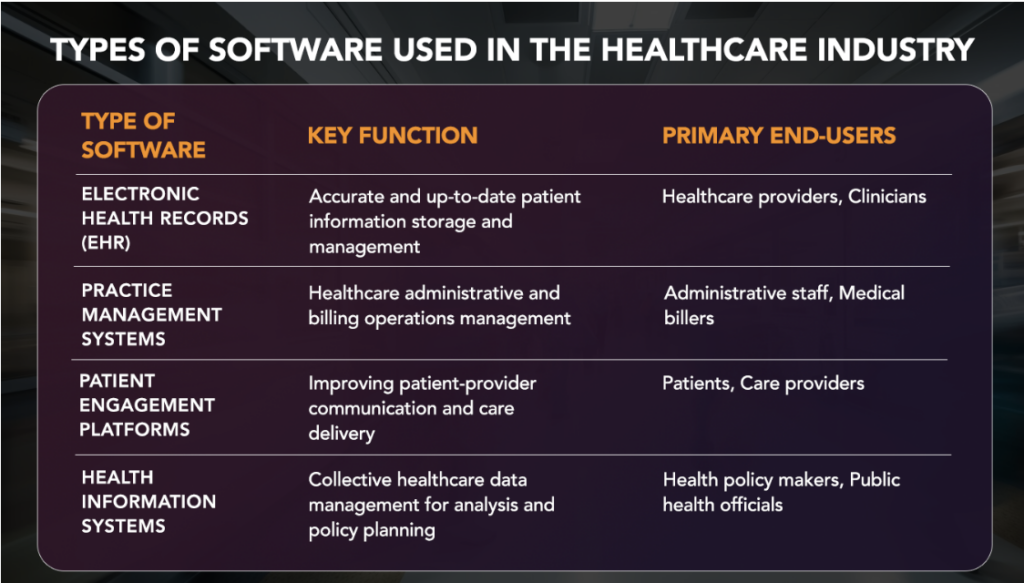
Electronic Health Records, now more than ever, are seen as the backbone of modern healthcare information systems, facilitating the seamless sharing and management of patient data among medical professionals.
Another quintessential category is Practice Management Systems, which aid healthcare providers in managing daily operations such as appointment scheduling, billing, and reporting. Integral to healthcare delivery are also Patient Engagement Platforms, designed to empower patients through easier access to personal health information and communication with care providers.
Lastly, Health Information Systems stand out for their capacity to encompass broader data analysis and manage healthcare data contributing to policy planning and evidence-based management. Together, these systems form an interconnected web that supports and enhances the healthcare delivery cycle.
With security and compliance being core priorities for both developers and healthcare providers, the modern healthcare landscape is constantly evolving to integrate these diverse health information systems into cohesive networks that safeguard patient privacy and improve healthcare outcomes.
The Process of Building Custom Healthcare Software
The genesis of any impactful healthcare application lies in the meticulous process of its creation. From preliminary planning to the deployment stage, building custom healthcare software is a journey anchored in deep insights into healthcare provider needs, patient welfare standards, and technological finesse. Within this circuitous trajectory, the paramount objectives are adherence to compliance standards and ensuring top-notch security protocols.
Recognizing healthcare providers’ reliance on sophisticated applications for daily operations, developers embark on a mission to innovate healthcare software solutions. These solutions bridge the gap between complex medical data and actionable insights, fostering environments where patient outcomes can be significantly improved.
Identifying Healthcare Needs and Software Objectives
Before the coding begins, it is essential to engage with healthcare professionals to dissect their requirements meticulously. The task is two-fold – understanding the operational intricacies and translating them into software objectives that can effectively streamline processes and elevate patient care. Intrinsic in this is the software’s potential ability to bend to the evolving needs of its users and the healthcare industry’s regulatory dynamics.
Key Considerations in Custom Healthcare Software Development
A fundamental dimension in developing healthcare applications is the convergence of user-centric design with unwavering data security. Essential factors such as healthcare software design, privacy policies, user accessibility, and patient engagement metrics are integral to the architecture of the software. Each feature must not only resonate with the user’s expectations but also align with healthcare regulations and data security protocols.
Designing for Compliance and Security in Healthcare Software
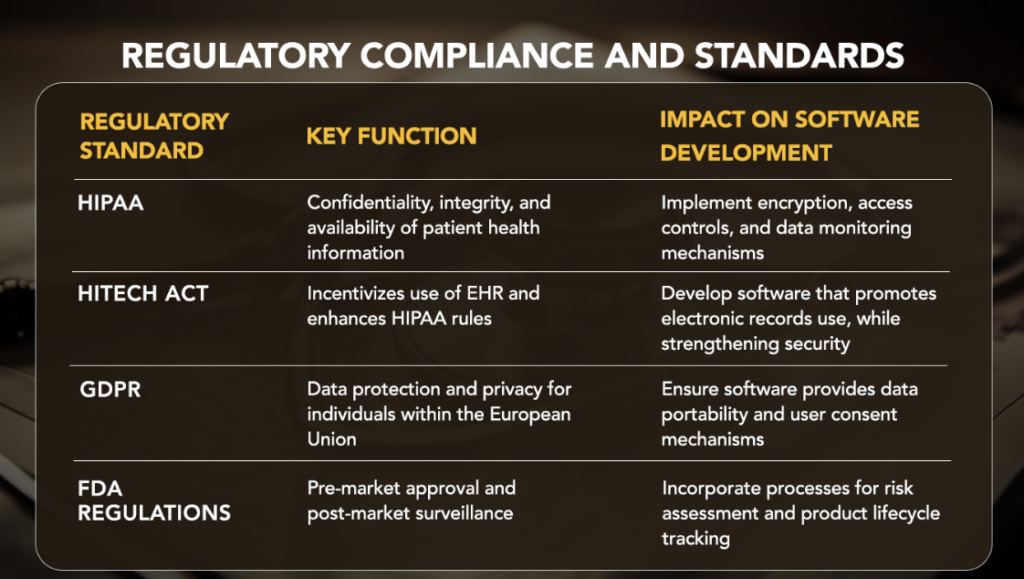
The sanctity of patient information and the trust in healthcare providers hinge upon uncompromised data protection and adherence to regulations like HIPAA and HITECH. Therefore, security in medical software development demands a fortified framework, with compliance in healthcare software being an irreplaceable cornerstone. Encryption, access controls, and regular compliance reviews are interwoven throughout the development process to ensure the resultant software embodies ironclad security measures, thereby guaranteeing the integrity of sensitive health information.
Essential Features of Healthcare Software
In the realm of modern medicine, the impetus is on leveraging technology for better health outcomes. By converging the technological milieu with healthcare needs, software developers aim to prime customizable healthcare applications for excellence. These essentials not only establish an indispensable baseline for healthcare IT but propel institutions to the forefront of medical innovation.
Must-Have Features for Effective Healthcare Solutions
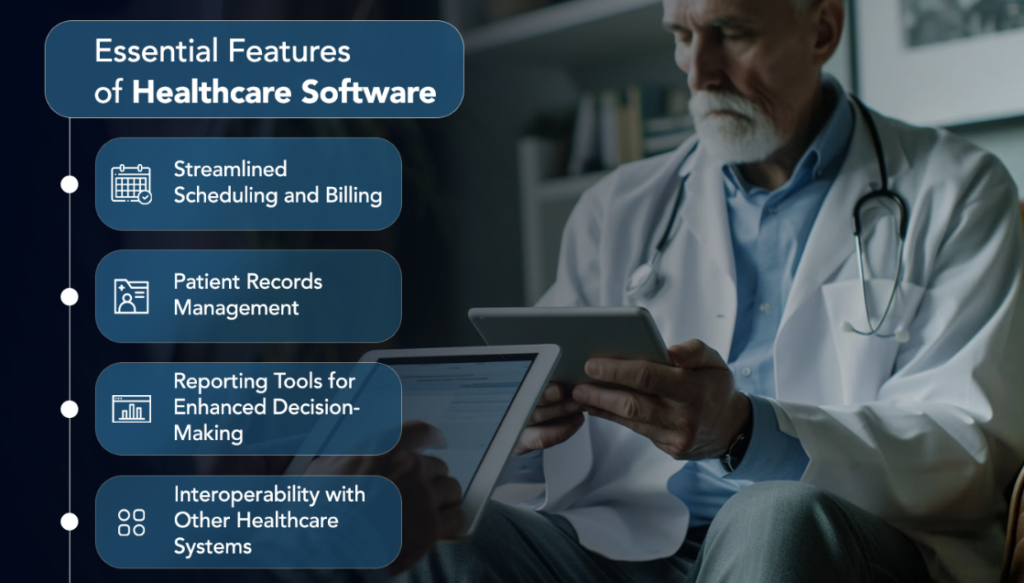
The advent of technology in healthcare has brought immense possibilities to the core functionalities of medical institutions. Effortless and robust workflow automation in healthcare sits at the heart of this innovation, offering unwavering support. This indispensable feature minimizes manual intervention by seamlessly orchestrating patient data flows, appointment scheduling, and medication tracking. With this foundation, medical professionals can devote their undivided attention to patient care.
- Streamlined Scheduling and Billing
- Comprehensive Patient Records Management
- Dynamic Reporting Tools for Enhanced Decision-Making
- Interoperability with Other Healthcare Systems
Another cornerstone lies in the domain of medical data analytics. The ability to extract, decipher, and employ data effectively can significantly transform clinical decisions and health outcomes. Advanced analytics serve as the looking glass, delivering insights that spur preemptive healthcare actions and strategic operational adjustments.
Advanced Features for Enhanced Healthcare Delivery
The current trajectory in healthcare technology points toward an advanced suite of features that deliver more than basic functionality.
- Artificial Intelligence and Machine Learning for predictive diagnostics
- Remote Patient Monitoring Tools for continuous care
- Telemedicine Capabilities for virtual patient engagement
- Personalized Healthcare Experiences with Custom Dashboards
- Real-time Communication Tools for Immediate Assistance and Feedback
By integrating these sophisticated attributes, custom software vaults beyond traditional boundaries. AI-driven diagnostics fine-tune the accuracy of healthcare services, remote patient monitoring augments the paradigm of care delivered to the less mobile or distant patients, and telemedicine bridles distances, providing expert consultation at the click of a button.
These enhanced features serve as testament to the transformational role of customized healthcare software in driving efficient, patient-centric care models. Simultaneously, they underscore the potency of real-time interactions and data-centric insights that pivot the delivery of healthcare services for unparalleled results.
In concert, these features interlace to create a tapestry of healthcare software that is not only functional and secure but also adaptable and proactive. Such a confluence of innovation and healthcare ensures a future where both providers and patients enjoy an optimized, interconnected healthcare experience.
Overcoming Challenges in Healthcare Software Development
As the digitization of healthcare continues to surge forward, it introduces a complex weave of challenges, notably in safeguarding sensitive health information and adhering to stringent regulatory frameworks. With healthcare data protection becoming increasingly critical, and ensuring patient privacy in healthcare technology a paramount priority, fulfilling these obligations necessitates a multifaceted approach that addresses security concerns and navigates the maze of regulatory compliance within healthcare IT.
Addressing Data Security and Privacy Concerns
To fortify defense against potential breaches, healthcare software development must incorporate robust security protocols. Advanced encryption methods, rigorous authentication processes, and ongoing threat assessments are critical measures in protecting against unauthorized access and ensuring the confidentiality of patient data. Emphasizing these layers of security throughout the development process reaffirms a commitment to the highest standards of patient privacy in healthcare technology.
These sophisticated data protection strategies are designed to not only respond to threats but also to proactively anticipate and prevent them. Healthcare entities that leverage technology to safeguard patient information not only maintain trust but also uphold their reputations as secure custodians of sensitive data.
Navigating Regulatory Compliance and Standards
The complex landscape of healthcare IT mandates thorough knowledge of regulatory compliance requirements. As a cornerstone of healthcare software creation, adherence to laws such as the Health Insurance Portability and Accountability Act (HIPAA) is non-negotiable. The dynamic nature of these regulations means that software must be designed with flexibility, to accommodate updates and revisions to existing laws.
Developers are required to create software that not only aligns with current healthcare IT standards but is also rigorously tested to preclude vulnerabilities. Regular audits and updates are part of this compliance-centric approach, which serves as a firm foundation for reliable and legal healthcare provision.
Ultimately, as the healthcare landscape evolves, robust methodologies that prioritize healthcare data protection, patient privacy, and regulatory compliance in healthcare IT will serve as the bedrock for overcoming these industry challenges. Doing so ensures that healthcare software development will continue to advance at the pace of technology while simultaneously protecting both practitioners and patients.
Successful Custom Healthcare Software Solutions
Delving deep into practical applications, healthcare software project analysis through real-world case studies reveals the pivotal elements of successful healthcare tech deployments. The insights gleaned from these healthcare IT case studies are not merely academic but offer tangible stepping stones for future endeavors within the medical software domain.
Analysis of Market-leading Healthcare Software
The healthcare software landscape is punctuated by stories of remarkable achievements and innovative solutions that have significantly impacted both providers and recipients of care. One illustrative example is the collaboration with Multipharma, a cooperative comprising over 200 pharmacies in Belgium. Multipharma’s initiative to digitize and automate their medicine preparation systems exemplifies the transformative power of custom healthcare software in streamlining pharmacy operations.
This joint venture underlines the import of automating workflows to enhance service quality. Patient wait times are reduced, prescription errors minimized, and the overall efficiency of medicine dispensation is increased, illustrating the profound effect of successful healthcare tech deployments.
Lessons Learned from Successful Implementations
The story of Multipharma provides crucial backdrops against which other healthcare institutions can gauge their software development aspirations. From the implementation phase, it becomes apparent that understanding what end-users, in this case, the pharmacists and their customers, genuinely require from the software is critical to deployment success.
Moreover, the focus on compliance with healthcare standards and practices has emerged as an indispensable criterion for success. Custom healthcare software solutions must not only serve operational needs but also stand up to rigorous data protection and patient privacy regulations.
These snapshots of healthcare technology triumphs encapsulate the myriad facets integral to the development of cutting-edge medical software. Emphasis on user satisfaction, task simplification, and stringent compliance frameworks becomes the unwritten manifesto for aspiring healthcare tech initiatives. As a whole, these case studies serve as benchmarks and knowledge repositories from which the industry can draw inspiration and insight.
Future Trends in Healthcare Software Development
The advent of transformative technologies heralds a new era in healthcare software development, marked by a convergence of innovation and healthcare needs. As we delve into the future, it becomes evident that the digitization of healthcare is set for seismic shifts, driven by emerging technologies that promise to redefine the delivery of healthcare services.
Emerging Technologies and Their Impact on Healthcare Solutions
Revolutionary strides in technology impact on healthcare, notably through Artificial Intelligence (AI), Blockchain, and the Internet of Medical Things (IoMT), have begun paving the way for advanced healthcare solutions. AI is transforming patient diagnostics with its predictive capabilities, while Blockchain is emerging as a cornerstone for securing sensitive health data and enhancing interoperability among disparate healthcare systems.
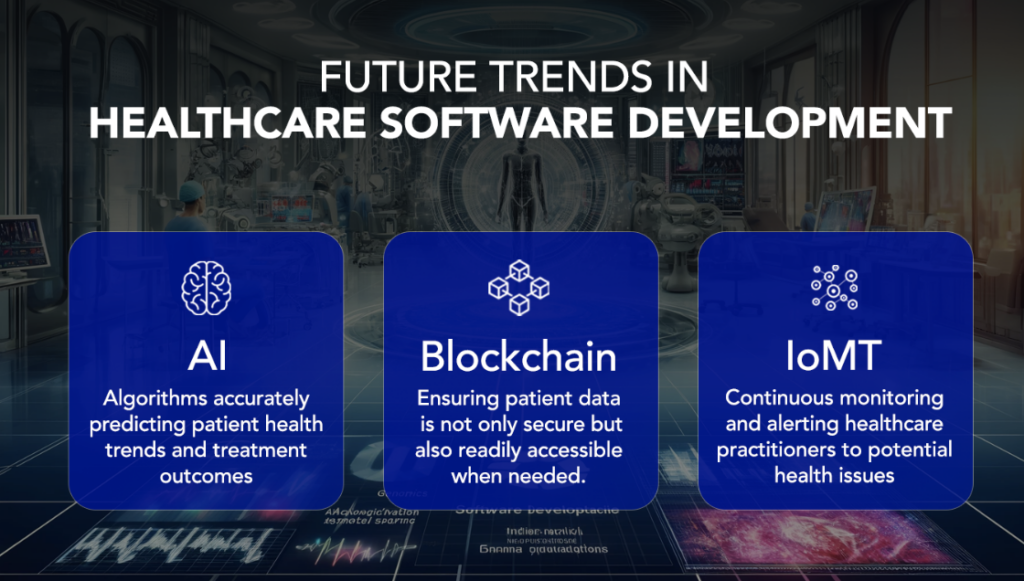
The IoMT stands as a beacon of innovation, connecting an array of medical devices to the healthcare IT ecosystem, and offering real-time monitoring and data analytics. This seamless interconnectivity not only enhances patient engagement but also optimizes healthcare delivery via accurate tracking and management of health conditions.
Predictions for Future Healthcare Software Innovations
The innovation in health tech solutions is poised for an unprecedented journey as software development continues to evolve. Here are some predictions for what we can expect:
- AI-driven analytics will facilitate personalized patient care, with algorithms accurately predicting patient health trends and treatment outcomes.
- Blockchain will revolutionize data sharing between healthcare entities, ensuring patient data is not only secure but also readily accessible when needed.
- The IoMT will lead the charge in proactive healthcare, with devices such as wearable sensors offering continuous monitoring and alerting healthcare practitioners to potential health issues before they become acute.
We’re on the cusp of a healthcare software evolution where solutions will not merely respond to changes; they will anticipate and lead the charge in shaping a future where technology serves as the backbone of patient care and healthcare delivery.
In light of these advancements, the future of healthcare software development will not be penned in historical terms but will be characterized by agile solutions that adapt dynamically to the evolving landscape, continually lifting the quality and efficacy of healthcare to new heights.
Conclusion: Building a Successful Healthcare Software Product
The roadmap to a successful healthcare software development journey is paved with precision, empathy, and technological mastery. Healthcare providers are in search of partners equipped with both the technical expertise and healthcare acumen necessary to navigate the intricate process of creating bespoke medical solutions. A synergy between the healthcare providers’ aspirations for efficacy and the developers’ arsenal of cutting-edge tools and methodologies is vital.
By carefully attending to each stage of the development process, from the initial requirements gathering to the polished stages of refinement and deployment, companies foster an environment conducive to healthcare digital transformation. It is within this digital metamorphosis that the true essence of modernized patient care and operational supremacy is realized.
Here is a snapshot of the strategic steps toward realizing a visionary healthcare software product:
- Discovery and ideation rooted in healthcare proficiency and user-centric design
- Conforming to regulatory compliances and integrating secure data practices
- Incubating innovation with AI, big data, and IoT to anticipate care evolution
- Supportive post-launch strategies fine-tuned through analytics and user feedback
Ultimately, the voyage towards a revolutionary healthcare software product is continuous and dynamic. It is the commitment to excellence and the relentless pursuit of improving healthcare outcomes that turn pioneering dreams into tangible realities you can trust.