
Aviation ERP integration connects ERP with procurement, inventory, MRO, quality, compliance, finance, supplier, logistics, and operational systems so aircraft parts, work orders, documents, approvals, and costs move without manual re-entry. It should give each system a clear owner while making parts, documents, holds, and costs visible at the moment a team must decide.
For aerospace manufacturers, MRO teams, airline technical operations, and parts distributors, ERP integration should reduce the gap between what is planned, what is in stock, what is approved for use, what is under quality hold, and what finance sees as committed cost. When those signals live in separate systems, teams compensate with spreadsheets, email, duplicate entry, and manual document checks. That works until lead times stretch, a serialized part needs full history, or an aircraft is waiting on one missing certificate.
Attract Group approaches aviation ERP integration as both a systems architecture problem and an operational workflow problem. Packaged ERP can cover finance, procurement, and inventory foundations, but aviation often needs stronger connections to maintenance planning, quality records, supplier evidence, and edge workflows outside the ERP screen.
What Aviation ERP Integration Should Connect
Aviation ERP integration should begin with the workflows that move parts, documents, approvals, and costs across teams. Most aircraft supply chains need ERP, MRO/CMMS, warehouse, supplier, quality, document, finance, logistics, BI, and technical-operations systems connected through explicit ownership and exception rules.
| System/workflow | Data exchanged | Business reason | Main risk |
|---|---|---|---|
| ERP | Vendors, POs, invoices, cost centers, inventory value, approvals | Keep purchasing, accounting, and inventory valuation in one controlled system | ERP becomes overloaded with aviation-specific process logic |
| MRO/CMMS | Work orders, task cards, maintenance plans, part demands, aircraft status | Connect maintenance demand to parts availability and procurement | Work-order changes may not reach purchasing or stores fast enough |
| Inventory/WMS | Bin location, serial/lot, serviceable status, quarantine, cycle counts | Give stores and planners a current view of usable stock | Status mismatches can release the wrong part |
| Procurement | RFQs, purchase orders, lead times, supplier confirmations, expediting notes | Reduce manual buying work and improve shortage visibility | Supplier updates may overwrite internal planning assumptions |
| Supplier portals | Quotes, ASN data, certificates, shipping details, acknowledgments | Capture evidence and shipment data before parts arrive | Poor validation can bring incomplete documents into the ERP |
| Quality management | Inspection results, nonconformance, quality holds, corrective actions | Stop nonconforming or unapproved parts before use | Quality status may not block warehouse issue transactions |
| Document management | Certificates, repair tags, release forms, manuals, lease-return records | Tie each part and transaction to retained evidence | Documents may be stored without reliable part linkage |
| Finance | Accruals, landed cost, project cost, variance, capitalization | Make operational decisions visible in financial reporting | Delayed sync can distort margin, budget, or cash forecasts |
| Logistics | Tracking, customs data, carrier updates, delivery events | Help teams react to transit delays and import issues | Carrier events may not map cleanly to internal milestones |
| BI/reporting | Shortages, supplier performance, turn time, inventory aging, cost trends | Give leaders operational and financial visibility | Reports become unreliable if master data ownership is unclear |
| Technical operations | Aircraft tail, configuration, maintenance window, deferrals, AOG demand | Connect supply-chain decisions to aircraft availability | Tail and configuration data may conflict across systems |
This is where aviation software development and ERP software development meet. The integration plan must define what each system owns, which events trigger updates, and which exceptions need human review.
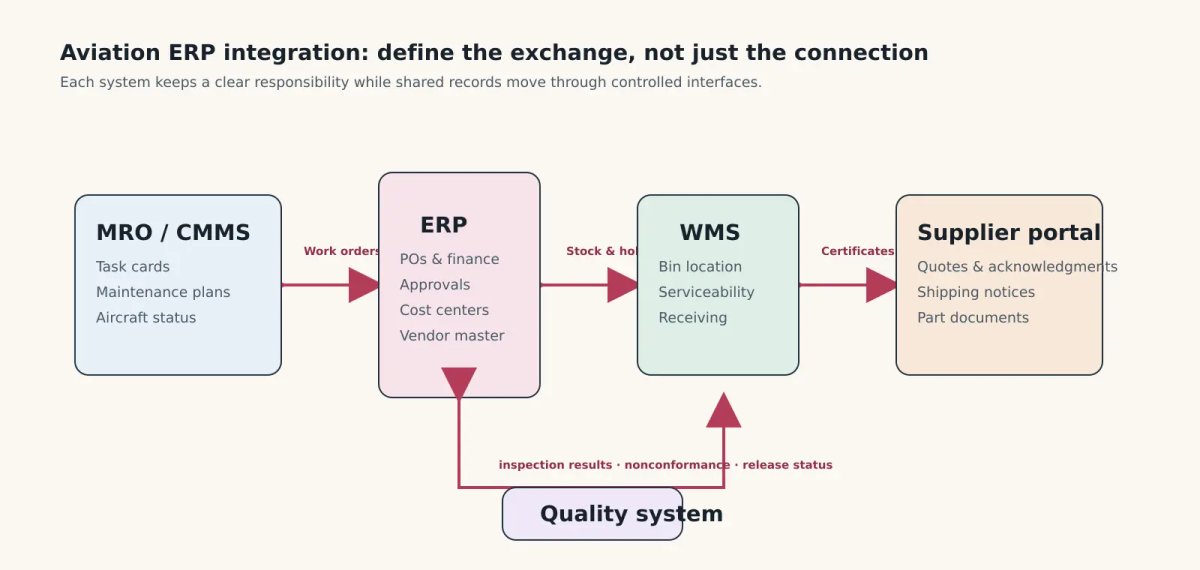
Define the system of record and exchanged data for each interface before building integrations.
How Integration Differs by ERP and MRO Platform
SAP, Oracle, Microsoft Dynamics, IFS, and Ramco Aviation have different extension models, data structures, and operational boundaries; AMOS, TRAX, and Quantum Control add another layer of maintenance and aviation-specific records. The integration design must follow the actual platform contracts, not a generic “ERP connector” promise.
| Platform | Integration emphasis | Common decision point |
|---|---|---|
| SAP | Governed master data, procurement/finance controls, APIs and middleware | Keep aviation workflow logic out of core customizations where an integration or side-by-side app is safer |
| Oracle | Financial, procurement, supplier and reporting flows | Decide which business events originate in ERP versus MRO/WMS before mapping interfaces |
| Microsoft Dynamics | Mid-market ERP configuration, warehouse and partner-facing workflows | Assess connector maturity and the custom module boundary early |
| IFS | Asset, maintenance, field-service and supply-chain fit | Align asset/maintenance records with aircraft and component traceability requirements |
| Ramco Aviation | Aviation-oriented maintenance and operations context | Confirm the system-of-record boundary with wider finance, warehouse and supplier systems |
| AMOS | Maintenance planning, task cards and technical records | Synchronize demand, part status and release evidence without duplicating maintenance truth |
| TRAX | MRO, engineering and maintenance execution | Map work-order and inventory events with strict serial and status controls |
| Quantum Control | Aviation inventory, purchasing and MRO workflows | Validate data access, document linkage, and growth path before expanding integrations |
Why Aircraft Supply-Chain Integration Is Harder Than Generic ERP
Aircraft supply chains have less tolerance for loose data than many other industries because parts are expensive, regulated, serial- or lot-controlled, time-sensitive, and tied to documents that prove origin, condition, and approval status. A missing record can delay a transaction; a wrong status can put quality, safety, and cost controls at risk.
Several aviation-specific conditions make integration harder:
- Life-limited parts need remaining-life data, usage history, and documentation that can follow the part across owners and maintenance events.
- Maintenance planning depends on aircraft status, upcoming checks, deferred items, and parts demand that may change quickly.
- Inventory needs serviceable, unserviceable, quarantine, repair, exchange, and scrap states, not only on-hand quantity.
- Supplier lead times can shift after a PO is placed, which affects maintenance windows and aircraft availability.
- Lease returns require records, part traceability, and configuration evidence to be assembled under time pressure.
- Certificates and release documents must be linked to the correct part, transaction, and receiving event.
- Audit trails must show who changed a record, when it changed, and why.
- Quality holds need to block downstream issue, installation, shipment, or billing steps.
IATA notes that fragmented record-keeping and inconsistent standards increase costs and slow aircraft transitions and parts transactions. Its aviation supply-chain work includes traceability and templates for serviceable parts, including life-limited parts during lease returns. That direction matters for ERP integration because the system architecture should support cleaner data exchange, not preserve disconnected records in digital form.
Supply-chain pressure is not theoretical. In an IATA article on aviation supply-chain turmoil, the organization states that supply-chain issues cost airlines more than $11 billion in 2025, with spare-part stocking adding about $1.4 billion in inventory costs. When companies carry more inventory to protect operations, they need better visibility into what is usable, where it is, what it cost, and whether it has the records required for release.
The move toward IATA Digital Aircraft Operations also points to a broader shift: aircraft operations need structured, connected data across technical, maintenance, and supply-chain workflows. ERP integration should be designed for that reality from the start.
The Cost of Leaving Systems Disconnected
Disconnected systems turn uncertainty into working capital, delays, and scramble work. IATA's cited $11 billion 2025 supply-chain impact and roughly $1.4 billion of additional spare-part stocking show the scale: without reliable status and traceability, teams overstock to protect availability, chase an AOG part through email, and assemble lease-return evidence under avoidable time pressure.
Traceability, Quality, and Compliance Requirements
Traceability is the core aviation ERP integration requirement because it lets a team prove a part’s origin, status, documents, approvals, and connected transactions without hunting across systems. The integration should make those answers available at receiving, issue, installation, return, and audit time.
- Where did this part come from?
- Which supplier provided it?
- Which certificate or release document came with it?
- Was it inspected, accepted, rejected, repaired, or quarantined?
- Has it been installed, removed, exchanged, returned, or scrapped?
- Who approved each step?
- Which aircraft, work order, PO, invoice, and inventory location are connected to it?
Part history must connect procurement, receiving, inspection, inventory, maintenance, and finance records. Approved-parts workflows should prevent a buyer, warehouse user, or technician from bypassing required checks. Nonconformance workflows should route failed inspections to quality teams, create holds, preserve evidence, and stop downstream use until the issue is resolved.
The FAA Suspected Unapproved Parts Program investigates SUP reports and notifies affected aviation parties when a part is determined to be unapproved. This is one reason aviation systems need part provenance, exception workflows, document retention, role permissions, and audit logs. ERP integration cannot make compliance decisions by itself, and this article is not legal advice. It can, however, make the required evidence easier to find and make exceptions harder to ignore.
A sound integration should enforce supplier qualification before PO approval, capture certificates at receiving, block inventory issue on a quality hold, and retain role-controlled evidence and audit logs for status, supplier, cost, and approval changes.
Build vs Buy: ERP Configuration, Integration Layer, or Custom Module
Not every aviation ERP problem requires custom software. Use ERP configuration for standard finance and purchasing controls, an integration layer for controlled cross-system exchange, and a custom module when aviation-specific field, traceability, or role workflow is too awkward inside packaged screens.
Standard ERP configuration usually works when the process is close to normal finance, procurement, or inventory control. Examples include purchase approvals, supplier master data, invoice matching, basic stock transactions, cost center reporting, and standard warehouse movements. If the ERP already supports the workflow cleanly, configuration is often faster and easier to govern.
An integration layer works when ERP remains the source of truth, but other systems need APIs, events, or scheduled data exchange. This is common when MRO, WMS, supplier portals, logistics systems, BI, and document repositories need to share data without pushing every user into the ERP. The integration layer can handle validation, retries, logging, mapping, and exception queues.
A custom module makes sense when the workflow is aviation-specific, field-heavy, or role-specific enough that ERP screens slow people down. Custom modules can support offline work, guided task flows, aircraft or part traceability, approval paths, supplier collaboration, or operational dashboards that the ERP cannot provide cleanly.
Attract Group's Vestergaard case is a useful example of operational software at the edge of aviation workflows. Attract Group built an offline-capable tablet app for aircraft de-icing operations with job creation, unit data, zone and temperature handling, guided workflow, fluids and notes, job history, offline local database logic, event logging, and traceability. This kind of module shows why aviation operations often need software outside standard ERP screens, especially where field users need reliable workflows under real operating conditions.
Attract Group also delivered a Jira-like CRM/ERP on-premises corporate system for reporting, workload allocation, project operations, analytics, Slack and email notifications, and Excel export. The case page lists a 9-month development timeline and a $50,000-$100,000 budget range. While this is not an aerospace case, it is relevant proof for ERP-adjacent workflow software where internal operations, reporting, permissions, and automation need a tailored system.
For companies comparing packaged AI supply chain software with custom development, the decision should come from workflow fit, data ownership, audit needs, and long-term maintainability. Custom software development is strongest where generic tools cannot support the process without workarounds.
Implementation Roadmap
Aviation ERP integration should be phased so the team can prove ownership, data quality, and exception handling on a high-risk workflow before connecting the rest of the estate. Start with a workflow where a wrong status, missing document, or delayed update has a visible operational cost.
1. Map workflows and sources of truth
Document how parts, work orders, certificates, POs, invoices, quality statuses, and approvals move today. Define which system owns aircraft tail, part number, serial number, supplier, PO, work order, certificate, quality status, inventory location, and cost center.
2. Create a data dictionary
Standardize names, formats, status values, required fields, validation rules, and relationships. A data dictionary reduces mapping confusion between ERP, MRO, WMS, supplier, and reporting systems.
3. Classify parts and workflows by risk
Separate low-risk consumables from serialized parts, life-limited parts, AOG demand, repairable inventory, exchange parts, and lease-return records. High-risk flows need stronger controls, testing, and exception handling.
4. Pick the integration pattern
Use APIs for near-real-time system interaction, events for workflow changes that need quick reaction, and batch sync for lower-risk reporting or periodic updates. Many aviation environments need a mix of all three.
5. Prototype the highest-risk integration
Start with a workflow where errors are costly, such as receiving serialized parts with certificates, syncing work-order demand to procurement, or blocking warehouse issue when quality status changes.
6. Build audit and exception flows
Every sync failure needs ownership, visibility, retry logic, and a path to resolution. Exceptions should be part of the operating model, not hidden in logs.
7. Migrate data in phases
Clean supplier, part master, serial, inventory, and document data before migration. Move critical records first, validate them, then expand.
8. Train users by role
Buyers, planners, warehouse users, quality staff, finance teams, and technical operations leaders need different training. Training should match the screens and decisions each role owns.
9. Monitor sync health after launch
Track failed messages, duplicate records, latency, missing documents, unresolved exceptions, and manual overrides. This is also where big data in aviation can support reporting and trend analysis when the data foundation is strong.
A short business analysis phase can prevent expensive rework here. The goal is to understand which process should change, which system should own the record, and which integration should carry the update.
Cost, Timeline, and Team
Budgets depend on the number of systems, data quality, ERP access, workflow risk, supplier participation, and whether custom modules are required. These planning ranges are useful for early scoping:
| Scope | Typical timeline | Planning budget |
|---|---|---|
| ERP integration audit and discovery | 3-5 weeks | $12k-$35k |
| Integration MVP for one or two workflows | 2-4 months | $50k-$150k |
| Multi-system aviation ERP integration with supplier, quality, inventory, and reporting workflows | 5-10+ months | $150k-$450k+ |
| Custom operational module or offline/mobile layer | Add 2-5 months | Depends on scope |
A practical team needs a product owner with authority, a business analyst, solution architect, integration engineer, ERP specialist, QA and DevOps coverage, plus accountable domain leads from supply chain, MRO, finance, and quality. Security support belongs in the delivery plan where sensitive records or supplier access are in scope.
The domain leads matter because many integration failures are process failures in technical clothing. If no one owns duplicate supplier records, part-number rules, quality status mapping, or certificate exceptions, the software will reflect that confusion.
Vendor Questions Before You Commit
Before choosing a vendor or implementation partner, test how the team handles aviation data, integration risk, and post-launch support. Focus on issues that change the implementation: record ownership, failure handling, approval controls, documentation, and operating responsibility after go-live, rather than a generic due-diligence checklist:
- Which system will own aircraft tail, part master, serial number, supplier, PO, work order, certificate, quality status, inventory location, and cost center?
- How will API limits, downtime, and rate throttling be handled?
- What audit logs will be available for data changes and sync events?
- What happens when a sync fails?
- How will duplicate supplier, part, or serial records be detected?
- How will approved-parts workflows be enforced?
- Where will certificates be stored, and how will retention be managed?
- How will role permissions work across ERP, MRO, supplier, and reporting systems?
- Which reports and exports will users still need after launch?
- What disaster recovery plan covers the integration layer and custom modules?
- Who owns the code, documentation, integration mappings, and deployment pipeline?
- What support is included after go-live?
These questions are especially important for MOFU and BOFU evaluation because the lowest quote may omit exception handling, monitoring, documentation, and user adoption. Those omissions usually surface after launch, when supply-chain and maintenance teams are already relying on the system.
How Attract Group Can Help
Attract Group helps aviation and operational teams map ERP workflows, design integration layers, and build custom modules where packaged ERP stops at the generic process. That can include discovery, architecture, API integration, supplier portals, reporting, mobile or offline operational tools, quality workflows, and ERP-adjacent internal platforms.
For aviation ERP integration, begin with a focused discovery that maps workflows, systems of record, and the riskiest handoffs, then define an MVP that proves traceability, sync reliability, and user adoption before a broader rollout.
Need an aviation ERP integration plan?
We can map workflows, systems of record, integration risks, and a realistic MVP for aircraft supply-chain operations.