
Choosing the best loyalty program software depends on four things: the complexity of your program rules, the integrations you need with existing systems, how much control you want over customer data, and how fast you need to launch. There is no single correct answer. A Shopify merchant running a simple points program has different requirements than a multi-brand retailer that needs omnichannel earning, tiered rewards, partner networks, and a custom mobile app. This guide walks through what loyalty software should do, which platforms fit which use cases, when to build versus buy, what integration work buyers routinely underestimate, and how to plan costs and timelines realistically.
According to HubSpot, 77% of consumers belong to up to five loyalty programs, and 93% earned or redeemed a reward in the prior six months. The market is mature enough that customers expect loyalty features. The question is not whether to offer a program but how to implement one that fits your business model without creating technical debt.
Interested in diving deeper into the world of loyalty programs in retail?
What the best loyalty program software should do
Before comparing vendors, define the functional baseline your program requires. Most loyalty platforms cover some subset of these capabilities:
- Customer identity and profiles. Unified customer records across channels, with the ability to merge accounts, track activity history, and segment by behavior.
- Points and rules engine. Configurable earning and redemption rules: points per dollar, bonus multipliers, category-specific earning, expiration policies, and custom triggers.
- Tiers and status levels. Automatic tier progression based on spend, visits, or points, with tier-specific benefits and downgrade rules.
- Promotions and campaigns. Time-limited bonus events, double-points days, referral bonuses, birthday rewards, and targeted offers based on segments.
- Omnichannel earning and redemption. Customers earn and spend rewards in-store, online, in-app, and through partner channels without friction.
- Mobile wallet and app support. Digital loyalty cards, push notifications, in-app reward tracking, and Apple Wallet or Google Wallet passes.
- Analytics and reporting. Program performance dashboards, cohort analysis, redemption rates, breakage estimates, and ROI tracking.
- Fraud controls. Velocity checks, duplicate account detection, suspicious redemption alerts, and admin override capabilities.
- Admin workflows. Non-technical staff should be able to manage promotions, adjust balances, resolve disputes, and configure rules without developer involvement.
Not every business needs all of these on day one. But understanding the full scope helps you evaluate whether a SaaS platform will cover your roadmap or whether you will outgrow it within a year. For more on the features that matter in retail and e-commerce apps, see our guide on must-have features for e-commerce mobile apps.
Best loyalty program software options by use case
The market segments roughly into four tiers. The right choice depends on your current scale, technical team, and program ambitions.
| Use case | Platforms to evaluate | Best for | Limitations |
|---|---|---|---|
| Shopify / e-commerce starter | Smile.io, Yotpo Loyalty, LoyaltyLion, Growave, Stamped, Rivo | Fast launch, low complexity, small teams. Plug-in setup with Shopify or similar platforms. | Limited rule flexibility, basic segmentation, constrained omnichannel support. |
| Mid-market retention suite | Yotpo (full suite), LoyaltyLion, Klaviyo ecosystem integrations, Kangaroo, Preferred Patron | Marketing-led programs with email/SMS integration, referral programs, reviews bundled with loyalty. | May require workarounds for complex multi-location or partner programs. Integration depth varies. |
| Enterprise loyalty engine | Talon.One, Antavo, Annex Cloud, Open Loyalty, Salesforce Loyalty Management, White Label Loyalty | Complex rules, multi-brand portfolios, omnichannel (online + POS + app), API-first architecture, large transaction volumes. | Higher cost, longer implementation, may need SI or development partner for integration. |
| Custom or hybrid build | Purpose-built platform using your own development team or a partner like Attract Group | Program is part of a unique app, marketplace, subscription model, POS flow, partner network, or proprietary data strategy. | Requires product management discipline, longer timeline, ongoing maintenance investment. |
A few practical notes on this table. Starter tools like Smile.io or Growave can get a basic points program live in days, which is genuinely useful for validating whether your customers respond to loyalty mechanics before investing more. Mid-market tools add campaign sophistication and multi-channel messaging but often assume your tech stack fits their integration model. Enterprise engines like Talon.One or Antavo offer API-first flexibility and can handle millions of members, but implementation timelines of three to six months are common even before customization.
The custom path makes sense when your loyalty program is not a bolt-on but a core part of the product experience. If you are building a marketplace, a subscription service, or a branded mobile app, the loyalty logic often needs to live inside your own codebase rather than in a third-party widget.
Build vs buy: how to choose the right loyalty architecture
The build-versus-buy decision is really a spectrum. Most mid-size and enterprise programs end up in a hybrid zone: buying foundational infrastructure (points ledger, tier engine) and building the unique customer-facing experience, integrations, and differentiated features on top.
| Approach | Best fit | Risks | Typical timeline |
|---|---|---|---|
| SaaS platform (buy) | Standard points/referral program, single sales channel, small team, need to launch fast. | Vendor lock-in, limited customization, data portability concerns, pricing scales with member count. | 2-8 weeks |
| SaaS + custom integrations | Program needs to connect to existing POS, CRM, ERP, or mobile app. Rules are moderately complex. | Integration scope creep, ongoing maintenance of connectors, API rate limits from vendor side. | 1-3 months |
| Custom MVP | Loyalty is a differentiator, not a commodity feature. Unique earning mechanics, partner networks, or app-native experience required. | Requires clear product spec, dedicated development resources, and ongoing iteration budget. | 3-5 months |
| Complex omnichannel platform | Multi-brand, multi-country, online + offline + app, partner coalition, advanced analytics, real-time personalization. | Significant investment, cross-team coordination, phased rollout recommended. | 6-12+ months |
A composable or headless architecture can bridge the gap. You might use an API-first loyalty engine for the points ledger and rules processing while building a fully custom front-end experience in your mobile app and website. This approach gives you the reliability of a proven back-end with the flexibility to design the customer journey your brand needs.
Integration requirements buyers underestimate
The loyalty platform itself is often 40-60% of the work. The rest is integration. Here are the systems that typically need to connect, and where teams get surprised:
- POS systems. In-store earning and redemption requires real-time API calls to the loyalty engine during checkout. Latency, offline fallback, and staff training are real concerns.
- E-commerce platform. Shopify, Magento, WooCommerce, or a custom storefront. Earning on purchase, displaying point balances, and applying rewards at checkout all need reliable hooks. Our e-commerce software development team sees this as the most common integration scope.
- CRM or CDP. Loyalty data should flow into your customer data platform for segmentation and personalization. Without this, your loyalty program operates in a silo.
- Email and SMS. Triggered messages for point earning, tier changes, reward expiration, and promotional campaigns. Klaviyo, Braze, Iterable, or similar tools need event data from the loyalty system.
- Mobile app. If you have a branded app, the loyalty experience should be native, not a webview. This means SDK integration or API calls for balance checks, reward catalogs, and transaction history. See our mobile app development services for how we approach this.
- Payments. Applying loyalty discounts or points-as-currency at checkout requires coordination with your payment processor.
- Customer service tools. Support agents need to view loyalty status, adjust balances, and resolve disputes from within their existing helpdesk (Zendesk, Freshdesk, etc.).
- BI and analytics. Exporting loyalty data to your data warehouse (BigQuery, Snowflake, Redshift) for cohort analysis, LTV modeling, and program ROI reporting.
- Consent and privacy. GDPR, CCPA, and similar regulations affect how you collect, store, and process loyalty data. Your platform needs consent management and data deletion capabilities.
- Fraud prevention. Loyalty fraud is a growing problem. Integration with fraud detection tools or built-in velocity checks and anomaly detection matter more as your program scales.
If you are running a loyalty program across physical stores and digital channels, expect the integration layer to be the most time-consuming and expensive part of the project. Budget accordingly.
Cost and implementation planning
Loyalty software costs vary widely, and vendor pricing pages rarely tell the full story. Here are realistic ranges based on what we see in the market:
SaaS subscription costs range from free tiers (Smile.io, Stamped) for very small programs to $500-$2,000/month for mid-market tools and $2,000-$10,000+/month for enterprise platforms. Most enterprise vendors price based on member count, transaction volume, or a combination. Expect annual contracts.
Implementation and integration costs are where budgets often surprise teams:
- Simple SaaS setup with a single e-commerce platform: $5,000-$15,000 if you use the vendor's native integration and need minimal customization.
- SaaS with custom integrations (POS, CRM, mobile app): $15,000-$75,000 depending on the number of systems and data complexity.
- Custom loyalty MVP (web + mobile + admin panel): $50,000-$150,000 depending on feature scope, number of platforms, and integration depth.
- Complex omnichannel loyalty platform: $150,000-$500,000+ for multi-brand, multi-country programs with real-time personalization, partner networks, and advanced analytics.
Ongoing costs include platform subscription, hosting (for custom builds), maintenance and bug fixes, feature iteration, and support. Plan for 15-25% of initial build cost annually for maintenance of custom systems.
The biggest cost driver is not the loyalty logic itself but the integration and data synchronization layer. A points engine is straightforward. Making it work seamlessly across six systems in real time is where the engineering effort lives.
A practical selection checklist
Whether you are evaluating a SaaS vendor or scoping a custom build with a development partner, these questions will surface the issues that matter:
Data ownership and portability. Who owns the customer and transaction data? Can you export it in standard formats? What happens to your data if you leave the platform?
API limits and flexibility. What are the rate limits? Is the API RESTful or GraphQL? Can you trigger custom events and build custom earning rules via API?
Rule engine flexibility. Can you create conditional earning rules (e.g., 2x points on category X for tier Y members during campaign Z)? How complex can rules get before you need vendor support?
Migration path. If you are moving from an existing program, can you import member balances, tiers, and transaction history? What is the migration process?
Security and compliance. SOC 2 certification, GDPR compliance, data encryption at rest and in transit, role-based access control for admin users.
Segmentation and targeting. Can you segment members by behavior, tier, location, purchase history, or custom attributes for targeted campaigns?
Admin control. Can non-technical staff manage promotions, adjust balances, and configure rules without filing support tickets?
Reporting and analytics. What reports are available out of the box? Can you export raw data to your BI tools? Is there real-time reporting or only batch?
Support and SLA. What support channels are available? What is the response time SLA? Is there a dedicated account manager for enterprise plans?
Lock-in and exit costs. What is the contract term? What are the penalties for early termination? How long does a migration take?
Roadmap transparency. Does the vendor share a product roadmap? How often do they ship updates? Are there breaking changes?
For teams exploring CRM software development alongside loyalty, make sure the two systems share a unified customer identity from the start. Retrofitting this later is painful.
How Attract Group approaches loyalty software projects
We build custom software for retail and e-commerce businesses, and loyalty programs are a recurring project type. Our approach depends on where you are in the build-versus-buy spectrum.
For teams that need a custom loyalty product, we scope the program rules, integration requirements, and MVP feature set before writing code. We work across web, iOS, and Android, and we build the admin panel and back-end APIs alongside the customer-facing experience.
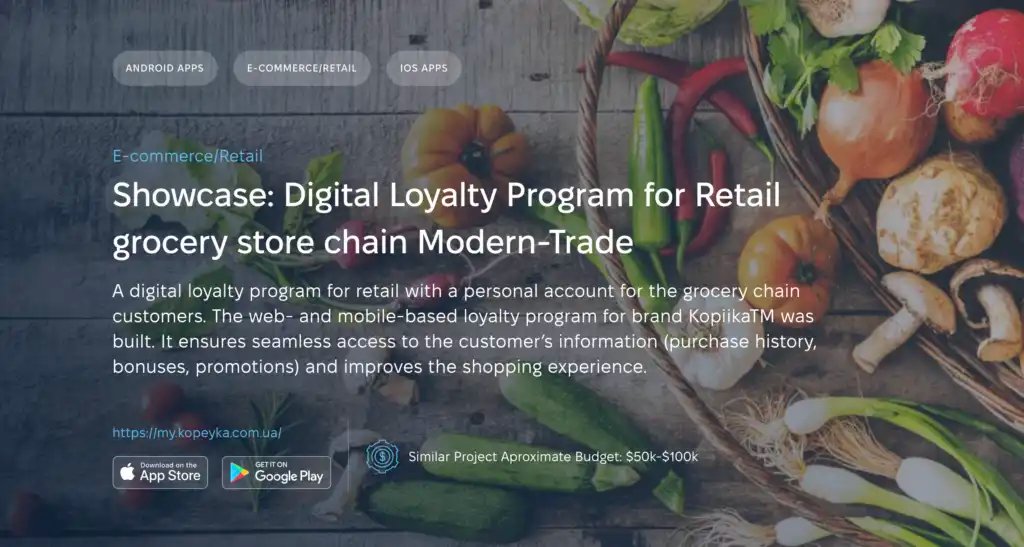
Digital Loyalty Program for Retail grocery store chain Kopiika
One example from our portfolio is the Kopiika digital loyalty program, a web, iOS, and Android loyalty ecosystem built for a retail client. The project included an admin panel, CRM synchronization, bonus mechanics, customer feedback collection, and store routing features. Development spanned over six months with ongoing long-term support, and the project fell within a $50K-$100K budget range. It is a representative example of what a mid-complexity custom loyalty build looks like in practice.
For teams that want to use a SaaS loyalty platform but need help with integration, we handle the connector work: POS integration, e-commerce platform hooks, mobile app embedding, CRM data sync, and analytics pipeline setup. This is often the fastest path for businesses that want proven loyalty infrastructure with a custom front-end or deep system integration.
We also work with retailers on broader e-commerce software development projects where loyalty is one module within a larger platform. If you are building a loyalty program for fashion and clothing retail or a custom retail software platform, the loyalty component benefits from being designed as part of the whole system rather than bolted on afterward.
Stay ahead with the latest tech solutions
Next steps
Before choosing a platform or a development partner, do the groundwork: document your program rules in plain language, map every system the loyalty program needs to touch, define what "MVP" means for your first launch, and identify the metrics you will use to measure program performance. That scoping exercise will tell you whether a SaaS tool covers your needs, whether you need a hybrid approach, or whether a custom build is the right investment. Start with the rules and integrations. The platform decision follows from there.