
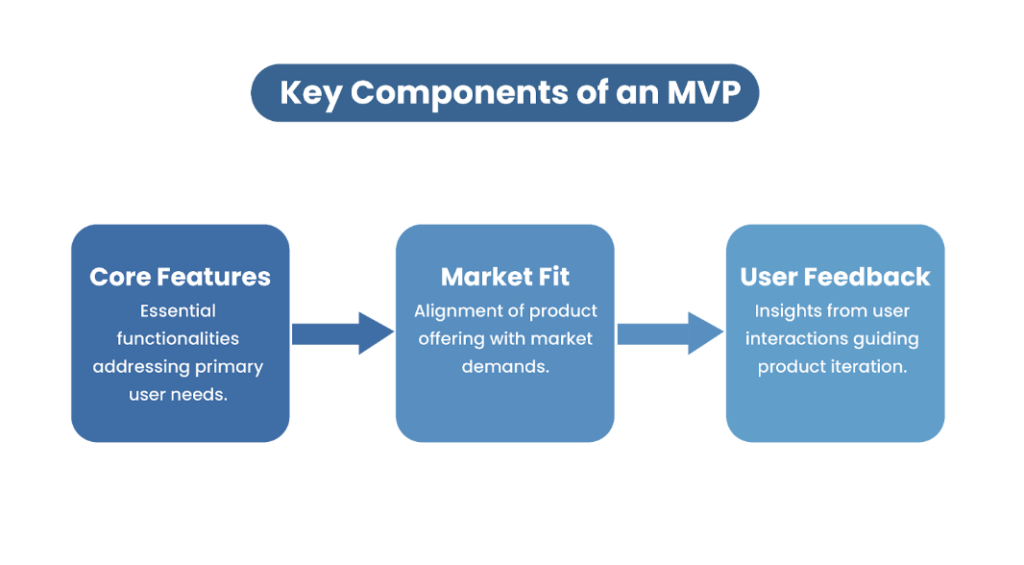
Most MVPs fail not because the idea was wrong but because the team over-engineered the first version or picked tools that created expensive rework three months later. Your mvp technology stack should be the smallest set of proven technologies that lets you test your riskiest assumption with real users. Everything else can wait.
This guide gives you a decision framework for selecting frontend, backend, database, mobile, and infrastructure tools based on what you are actually building, what risk you need to retire first, and how much time and money you have.
Why Stack Decisions Matter More for MVPs Than for Mature Products
In a mature product, you can absorb a bad technology choice. You have revenue, a team, and time to refactor. In an MVP, a wrong choice compounds fast:
- Picking a language nobody on your small team knows adds weeks of learning before a single feature ships.
- Choosing a self-hosted database when a managed service costs $25/month burns DevOps time you do not have.
- Building a custom auth system when Firebase Auth or Auth0 covers your needs delays the features that actually test your hypothesis.
The goal is not to pick the "best" technology. It is to pick the technology that gets you to user feedback fastest with the least throwaway work if you need to scale later.
Match Your Stack to the Risk You Need to Test
Before comparing frameworks, identify the primary risk your MVP must address. The risk determines which layer of the stack deserves the most attention and where you should use off-the-shelf solutions.
Market risk (Will anyone pay for this?): Optimize for speed to launch. Use no-code or low-code tools for the frontend, a simple backend, and third-party services for payments and analytics. You need landing pages and a transaction flow, not a custom rendering engine.
Usability risk (Can users complete the core workflow?): Invest in the frontend. Pick a component-based framework like React so you can iterate on UI quickly. The backend can be a thin API or even a BaaS like Supabase.
Integration risk (Can we connect to the partner API, device, or data source?): Spend your budget on the backend and middleware. Choose a language your team already knows well so debugging third-party integrations does not stall progress.
Scalability risk (Will the architecture hold if early traction is strong?): This is rare for a true MVP, but if your product is a marketplace or real-time platform, choose a backend runtime like Node.js or Go that handles concurrent connections efficiently, and use a managed cloud database from day one.
Compliance risk (Are there regulatory constraints like HIPAA, PCI, or GDPR?): Use cloud providers with compliance certifications (AWS, GCP, Azure) and managed services that handle encryption at rest and in transit. Do not build your own data storage layer.
Stack Recommendations by Product Type
The table below maps common MVP categories to practical technology choices. These are starting points, not mandates. If your team already has deep experience in a different stack that fits the constraints, use what you know.
| MVP Type | Frontend | Backend | Database | Cloud / Infra | Notes |
|---|---|---|---|---|---|
| Web SaaS | React or Next.js | Node.js (Express/Fastify) or Python (Django) | PostgreSQL (managed) | AWS, Vercel, or Railway | Next.js gives you SSR for SEO if content matters |
| Two-sided marketplace | React or Next.js | Node.js or Ruby on Rails | PostgreSQL | AWS or GCP | Rails scaffolding speeds up CRUD-heavy admin panels |
| Mobile app (single platform) | SwiftUI (iOS) or Jetpack Compose (Android) | Node.js or Python (FastAPI) | PostgreSQL or Firestore | Firebase or AWS Amplify | Native gives best UX for hardware-dependent features |
| Cross-platform mobile app | Flutter or React Native | Node.js or Python | PostgreSQL or Firestore | Firebase or AWS | Flutter compiles to iOS, Android, web, and desktop from one codebase |
| AI / data MVP | React (lightweight dashboard) | Python (FastAPI) | PostgreSQL + vector store (pgvector or Pinecone) | AWS (SageMaker or Lambda) | Keep the ML pipeline separate from the user-facing API |
| Regulated product (health, finance) | React or Angular | Java (Spring Boot) or C# (.NET) | PostgreSQL (managed, encrypted) | AWS GovCloud or Azure | Use compliance-certified managed services for storage and auth |
Frontend: Pick for Iteration Speed
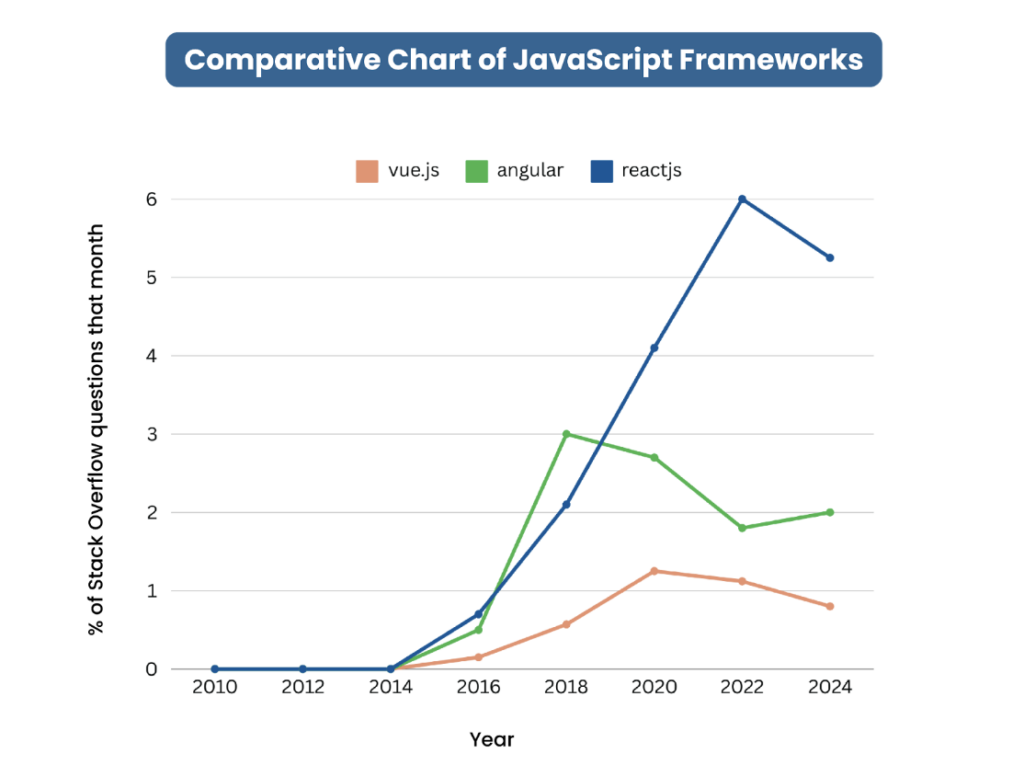
For most MVPs, React is the pragmatic default. It has the largest ecosystem of component libraries, the widest hiring pool according to the 2025 Stack Overflow Developer Survey, and a component-based architecture that makes it straightforward to swap UI elements as you learn from user testing.
When to choose something else:
- Next.js if your MVP depends on organic search traffic (server-side rendering improves indexing).
- Angular if you are building a complex form-heavy enterprise tool and your team already uses TypeScript heavily.
- A no-code builder (Webflow, Bubble) if your MVP is a content site or simple booking flow and you need to launch in under two weeks.
Avoid choosing a frontend framework because it is trending. Choose it because your team can ship screens in it this week.
Need Expert Front-End Developers?
Our skilled team can help you choose and implement the right front-end framework for your MVP, ensuring a seamless user experience.
Backend: Optimize for What You Already Know
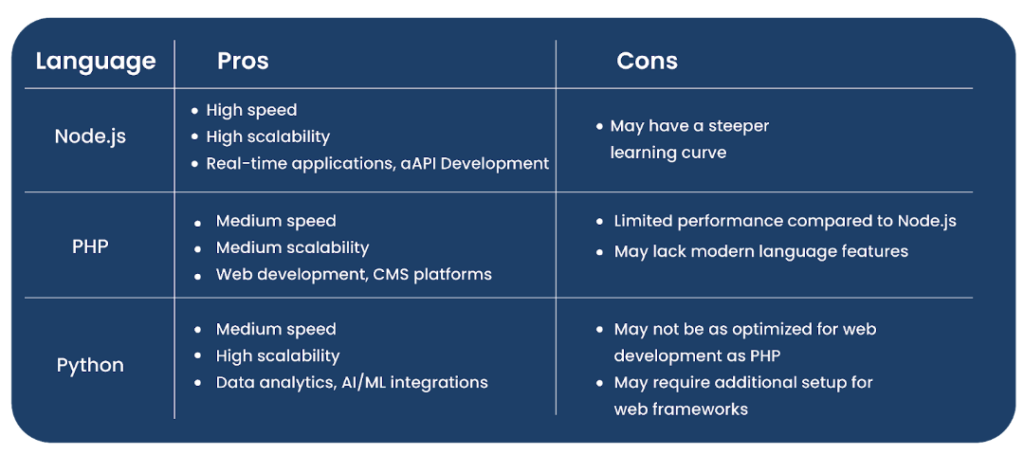
The backend language matters less than the backend architecture decisions. A well-structured Node.js API and a well-structured Django API will both serve an MVP with a few thousand users. What matters:
- Use a language your team writes daily. Switching from Python to Go for an MVP because Go is faster in benchmarks is almost always a net negative on timeline.
- Use a framework with built-in conventions. Rails, Django, and Laravel all provide ORM, routing, auth scaffolding, and admin panels out of the box. Express and FastAPI are lighter but require you to make more decisions yourself.
- Start with a monolith. Microservices add deployment complexity, inter-service communication overhead, and debugging difficulty. A single deployable unit is easier to reason about when you have two to four developers.
Serverless as a Backend Shortcut
For MVPs with unpredictable or low traffic, serverless functions (AWS Lambda, Google Cloud Functions, Vercel Serverless) eliminate server management entirely. AWS Lambda pricing is based on requests and compute duration, so you pay near-zero when nobody is using the product and scale automatically if a Product Hunt launch drives a traffic spike.
Serverless works well for API endpoints, webhook handlers, and scheduled jobs. It works poorly for long-running processes, WebSocket connections, or workloads that need persistent in-memory state.
Build a Scalable MVP Backend
Our back-end developers can help you select and integrate the optimal server-side technologies, including serverless architectures, for a robust and future-proof MVP.
Database: Start Managed, Stay Relational
PostgreSQL hosted on a managed service (AWS RDS, Supabase, Neon, or Railway) is the right default for most MVPs. It handles relational data, JSON documents, full-text search, and even vector embeddings (via pgvector) in a single engine. You avoid the operational burden of backups, patching, and failover.
When to add a second data store:
- Redis for caching or session storage if response times matter (real-time dashboards, chat).
- Firestore or DynamoDB if your data model is document-oriented and you want zero-config scaling.
- A dedicated vector database (Pinecone, Weaviate) only if your core feature is semantic search or RAG-based AI and pgvector does not meet latency requirements.
Do not add MongoDB, Elasticsearch, and Redis alongside PostgreSQL in your MVP. Each additional data store doubles your operational surface area.
Build vs. Buy: Where to Use Third-Party Services
Every hour your team spends building commodity functionality is an hour not spent on the feature that differentiates your product. Here is a practical breakdown:
| Capability | Build It Yourself? | Recommended Services |
|---|---|---|
| Authentication | No | Auth0, Firebase Auth, Clerk, Supabase Auth |
| Payments | No | Stripe, Paddle |
| Transactional email | No | Resend, Postmark, SendGrid |
| Push notifications | No | Firebase Cloud Messaging, OneSignal |
| Analytics | No (for MVP) | Mixpanel, PostHog, Amplitude |
| Search | Only if search IS the product | Algolia, Meilisearch, Typesense |
| Chat / messaging | Only if chat IS the product | Stream, Sendbird |
| CMS for content pages | No | Sanity, Contentful, Strapi |
| Core business logic | Yes | Skip |
| Custom data models | Yes | Skip |
| Differentiating UX flows | Yes | Skip |
The rule: if a third-party service covers 80% of your need and costs under $100/month at MVP scale, use it. You can replace it later if the product succeeds and the service becomes a bottleneck or cost problem.
Mobile: Native, Cross-Platform, or Web App
If your MVP hypothesis can be tested in a mobile browser, ship a responsive web app first. It avoids App Store review delays and lets you update instantly.
If you need device capabilities (camera, Bluetooth, health sensors, push notifications), choose between native and cross-platform:
- Cross-platform (Flutter or React Native) saves 30-40% of development time compared to maintaining two native codebases. Flutter is particularly strong for MVPs because its widget system produces consistent UI across platforms and hot reload accelerates iteration. Attract Group used Flutter to build SleepTrack, a sleep-monitoring app with Fitbit integration, shipping iOS and Android versions in three months within a $10k-$20k budget.
- Native (SwiftUI / Kotlin) is worth the extra cost only when your core value proposition depends on platform-specific performance (AR, complex animations, low-latency audio).
For most MVPs targeting both platforms, cross-platform development through a mobile development partner is the faster path to market.
DevOps and Deployment: Keep It Simple
Your MVP deployment pipeline needs three things: a staging environment, automated deploys on merge to main, and basic monitoring (uptime checks, error tracking).
Practical setup for most MVPs:
- Hosting: Vercel or Railway for web apps. AWS ECS or Fly.io if you need containers. Firebase Hosting for static frontends.
- CI/CD: GitHub Actions. It is free for public repos and cheap for private ones.
- Error tracking: Sentry (free tier covers MVP-scale traffic).
- Uptime monitoring: BetterStack or UptimeRobot.
Do not set up Kubernetes, multi-region failover, or blue-green deployments for an MVP. These are scaling concerns. If your MVP succeeds, a DevOps and cloud team can introduce them when traffic justifies the complexity.
Streamline Your MVP Deployment
Our DevOps experts can help you implement CI/CD pipelines, containerization, and other deployment tools for efficient and continuous MVP delivery.
AI Features in Your MVP: When They Belong and When They Do Not
Adding AI to an MVP makes sense only when the AI capability is the core value proposition (e.g., an AI writing assistant, a diagnostic tool, a recommendation engine). If AI is a nice-to-have feature, defer it.
When AI is central to your MVP:
- Use hosted model APIs (OpenAI, Anthropic, Google Gemini) rather than training or fine-tuning your own model.
- Keep the AI call behind a simple API endpoint so you can swap providers without rewriting the frontend.
- Budget for API costs. LLM inference at scale is not cheap, so validate willingness to pay before optimizing cost.
If you need AI integration as part of your core product, plan the data pipeline and prompt architecture early. Bolting AI onto a finished MVP often requires restructuring the backend.
Team and Vendor Checklist Before You Commit
Whether you are hiring developers or working with an MVP development partner, ask these questions before locking in a stack:
- Has this team shipped a production product in this stack in the last 12 months? Recent experience matters more than years of experience.
- Can they show you a working deployment pipeline, not just code? An MVP that cannot be deployed reliably is not an MVP.
- Do they default to third-party services for commodity features? A team that wants to build custom auth and custom email delivery for an MVP is optimizing for the wrong things.
- Will they document architecture decisions? If you switch vendors or hire in-house later, you need to understand why choices were made.
- What is their plan when requirements change mid-sprint? MVP requirements always change. The team should expect this, not resist it.
For startups building their first product, the right partner reduces stack risk by bringing tested patterns from previous launches rather than experimenting on your budget.
What to Do Next
Map your MVP to one of the product types in the table above. Identify your primary risk. Choose the simplest stack that addresses that risk with tools your team already knows. Use third-party services for everything that is not your differentiator. Then ship, measure, and decide whether to invest further in the architecture or pivot the product.
If you need help selecting a stack or want a team that has shipped MVPs across web and mobile, start a conversation with Attract Group before you write your first line of code.