
Requirements management is the work of capturing what a system needs to do, keeping it organized, and keeping it current as the project changes, from the first idea through to the tasks developers actually build. On a small project you can hold most of it in your head. On a large or long-running one you cannot, and the gap between what was agreed and what anyone can find written down is where projects quietly go wrong.
The usual story is familiar. Requirements live in a mix of meeting notes, a few documents, a ticket system, and several people's memories. None of those agree with each other for long. A feature gets discussed, half-built, and forgotten. A tester opens a task and cannot tell what it was supposed to do. A stakeholder asks whether something they signed off on ever shipped, and nobody can say for sure. This is not a discipline problem. It is what happens when requirements are scattered across places that do not stay in sync.
This piece is about a different way to handle that, one we have been using on complex projects: keep requirements in a single place that both your team and an AI model can read, and let the model do the upkeep that humans never get around to. It connects to three more detailed guides, on legacy system modernization, on the requirements traceability matrix, and on writing good user stories.
Where requirements management breaks down
On a fast-moving project, requirements drift faster than anyone updates the record of them. You agree something in a call, the code moves on, a decision gets reversed two weeks later, and the document describing the original plan sits untouched. After a few rounds of that, the written requirements are fiction, and people stop trusting them, which makes them stop maintaining them, which makes it worse.
The damage shows up in predictable places. Estimates are guesses because nobody has a clear picture of the whole system. Onboarding is slow because there is nothing reliable for a new person to read. Testing misses things because the link between a task and the requirement behind it was never recorded. And work gets duplicated or dropped because two people had different versions of the plan in their heads. Every one of these traces back to the same root: the requirements and the reality came apart, and nothing kept them together.
Why Confluence and Jira alone do not hold up
The standard answer is a wiki for documents and a tracker for tickets, usually Confluence and Jira or something like them. They are fine tools and most teams have them. They also do not solve this problem, for a reason that is easy to miss.
A wiki stores documents. It does not keep them connected to each other or to the code, and it does nothing to tell you when a page has gone stale. A tracker stores tickets, but a ticket is a unit of work, not a record of what the system does. Neither tool reads your requirements as a whole and tells you where they contradict each other. So the documents rot, the tickets pile up, and the knowledge you actually need lives in the space between them where no tool is looking. Teams reach for a confluence alternative not because the wiki is bad at being a wiki, but because a pile of pages is not the same as a connected, current picture of the system.
The point is not to throw those tools out. It is to stop expecting a document store and a ticket queue to give you something neither was built to give.
One knowledge base your team and an AI can both read
The model we use starts by separating two kinds of information that teams usually mix together.
On one side is source material that should never be edited: the raw meeting transcripts (we keep them straight from Fathom), any original requirement documents, and the codebase itself. This is the record of what was said and what exists. You do not let anyone, human or model, quietly rewrite it.
On the other side is a living description of the system that the team revises as it learns. We keep this as linked notes in Obsidian, written in plain language, one part of the system at a time. Obsidian connects the notes into a graph, which matters because it lets a model move from one part of the system to a related one the way a person would, instead of reading isolated pages. Claude can read everything, the immutable sources and the living description both, but it is only allowed to change the living description, never the source record.
That split is the whole trick. The sources stay trustworthy because they are never edited. The living description stays useful because it is allowed to change. And because both are in a form a model can read, you get an assistant that actually knows your project rather than one you have to brief from scratch every time.
From idea to task without losing the thread
The second half of requirements management is the flow from a vague idea to a task a developer can pick up. Skipping steps here is how teams end up with tickets nobody can test.
It usually starts one of two ways: a stakeholder has an idea, or a document arrives with a request in it. Either way, the first move is a brief, a short draft that states the idea clearly enough to react to. The brief goes to the people who will build it and the person who asked for it, and it collects comments, corrections, and estimates as it goes. When everyone agrees on the brief, it becomes the basis for user stories with clear acceptance criteria. Those stories go through a prioritization pass that decides what is actually being built now versus later. Only then do tasks get created, each one linked back to the specific story it came from.
That last link is the one teams skip and the one that matters most. When a task points back to its story and acceptance criteria, the developer knows what done means and the tester knows what to check. When it does not, both of them guess.
Two ways to track every requirement
To keep all of this legible as it grows, we track each requirement on two separate axes.
The first is the state of the text: draft, ready, or approved. This says how settled the requirement is. Draft means it is still being worked out. Approved means the stakeholder and the developers have both signed off and it can be built.
The second is the state of the work: implemented, a known gap, or sitting in the backlog. A gap is something agreed but not yet built, which is exactly the kind of thing that disappears without a record. The backlog splits further into what is in scope now, what is deferred, and what is genuinely undecided, because long projects generate ideas that you neither want to build yet nor want to lose.
Together these two axes answer the questions that matter at any moment: is this settled, and has it been built? A requirement that is approved but not implemented is your next work. One that is implemented but only ever in draft is a documentation gap. You can see both at a glance instead of discovering them in a crisis.
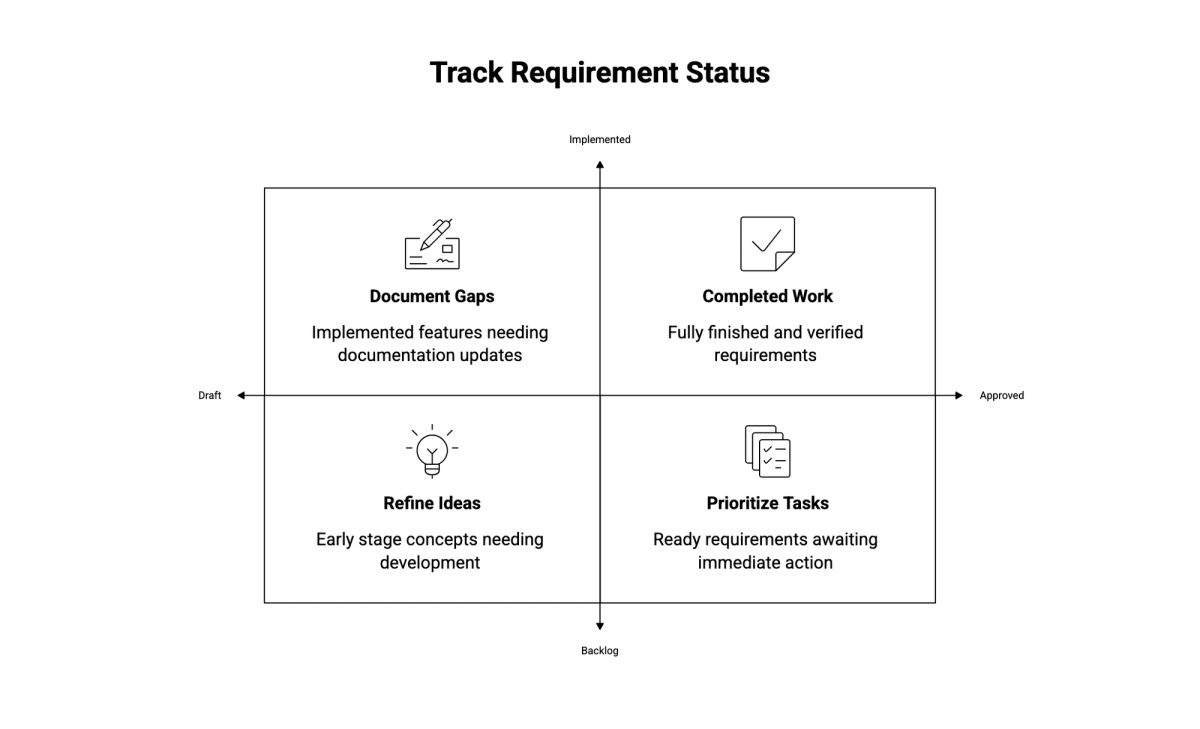
Tracking each requirement on two axes answers both questions at once: is it settled, and has it been built?
Keeping it all traceable
Tracking states is only useful if the things being tracked are connected. A requirement links to its acceptance criteria, the criteria link to the tests that verify them, defects link back to the criteria they violate, and tasks link to the story they came from. Walk those links in either direction and you can answer what was built, what was tested, and what a proposed change will affect.
This is traceability, and it is worth its own treatment, which is why we cover it in detail in the guide to the requirements traceability matrix. The short version: traceability is what turns "I think we tested that" into "here is the test, here is the result." On a complex project it is the difference between confidence and hope.
Where AI actually helps, and where it does not
It is worth being precise about this, because the technology gets oversold.
AI is good at the work that humans skip because it is tedious. It reads a large codebase or a stack of old meetings far faster than a person and produces a first description to react to. It navigates the linked knowledge base and answers questions about how the system fits together. And it checks the record for consistency: a requirement with no test, a description that now contradicts another, a link that points at something that has since changed. On our projects an automated check runs over the knowledge base and raises those as questions for a person to resolve, rather than fixing them silently. That last detail matters. A model that edits the record on its own is a model that introduces errors nobody catches.
What AI does not do is decide what a requirement means, judge a trade-off, or take responsibility for a call. Those stay with people. The honest framing is that the model removes the transcription and bookkeeping that make requirements rot, and leaves the judgment where it belongs. Used that way it is genuinely useful. Sold as a replacement for thinking, it is not.
What this changes in practice
When the requirements stay current, the downstream effects are concrete rather than inspirational. Estimates improve because there is a real picture of the system to estimate against. New people contribute sooner because there is something accurate to read. Testing catches more because the link from task to requirement is always there. And when a stakeholder changes their mind, which they will, you can see what that change touches instead of finding out in production.
It also changes what is possible on an older system. If you are taking on software whose requirements were never written down, the same approach lets you reconstruct what the system does before you change it, which we cover in the guide to legacy system modernization. The method is the same whether you are documenting forward from new ideas or backward from existing code.
How we approach this in practice
A few lessons from using this on real projects. The structure is not the hard part; the discipline is. The split between immutable sources and the living description only works if everyone respects it, so the rule that the model never edits the source record is one we enforce rather than hope for. Starting small matters too. Teams want to move every project into the new setup at once, and that is how it collapses under its own weight before it has proven anything, so we take one project, get it working, and expand from there. We also resist building out an elaborate structure before there is content to fill it, because an empty framework is just one more thing to maintain. Attract Group has built custom software since 2011, with a distributed team across time zones around the world, and this is the approach we reach for on the projects complex enough to need it.