
Choosing a development model is rarely a clean price comparison. For a startup, the better question is how fast you need to learn, how much runway you can risk, and where the product knowledge must live. Freelancers can be the right fit for narrow prototypes. A software development agency for startups can help ship a tested v1 when the product has workflows, integrations, or compliance needs. In-house teams make more sense once the product direction is proven and the company needs compounding product knowledge. Dedicated and hybrid teams sit in the middle, giving you capacity without asking you to build a full engineering org too early.
Software development for startups by funding stage
The best model changes as a startup moves from idea risk to execution risk. Early on, speed and learning matter more than team structure. Later, continuity, architecture, hiring discipline, and product ownership carry more weight. Pick the model that helps the company reach its next proof point without creating avoidable handoff debt.
| Stage | Best-fit model | Why it works | Watchouts | Handoff trigger |
|---|---|---|---|---|
| Bootstrapped or pre-seed | Founder-led build, freelancer, no-code specialist, or small discovery team | Keeps burn low while testing demand and narrowing scope | Overbuilding, weak technical decisions, poor documentation, vendor lock-in | Users repeatedly ask for the same workflow, or manual operations start blocking sales |
| Seed | Agency, senior freelancer plus fractional CTO, or small hybrid team | Ships a credible v1 while the startup is still learning what users will pay for | Treating the first release as a full platform, unclear acceptance criteria, lack of repo ownership | Product usage shows repeatable behavior and the roadmap becomes clearer than the experiment list |
| Series A | In-house product engineering core plus selected agency or dedicated team support | Product knowledge starts becoming company IP, while outside capacity can cover integrations, QA, DevOps, or mobile | Hiring too slowly, losing delivery speed, splitting ownership across too many vendors | Internal team can own architecture, roadmap tradeoffs, incidents, and release quality |
| Growth stage | In-house team with dedicated development team extensions for defined streams | Expands delivery capacity without rebuilding every function from scratch | Coordination drag, inconsistent engineering standards, weak onboarding | External team should either become a stable extension or transfer work to internal owners |
This stage view prevents a common mistake: choosing the cheapest option before you know which risk you are buying down. A $10,000 prototype that proves no one wants the workflow can be a good spend. A $30,000 codebase that cannot be maintained can become expensive very quickly. A full-time senior hire can be smart after traction, but premature when the product is still changing every week.
For very early products, it is often wise to keep the first version narrow. Y Combinator's MVP planning guidance points founders toward a small first version that tests the core assumption quickly rather than a broad product plan. That does not mean every startup needs a throwaway prototype. It means the build model should match the learning goal.
Agency vs freelance vs in-house: what each model is really buying
Agency, freelance, in-house, dedicated-team, and staff-augmentation models solve different problems. The practical choice comes down to the work you need done, who owns product and technical decisions, and how soon you need a dependable release. Treat staff augmentation as capacity inside your operating model, not outsourced product ownership.
| Model | Planning cost | Ramp to productive work | IP ownership | Coordination burden | Best for |
|---|---|---|---|---|---|
| Freelancer | $25–$150+/hour | Days to 2 weeks | Startup if contracted correctly | High for founder | A narrow, well-specified task |
| Agency | Fixed scope or blended team rate | 2–4 weeks; 8–16 weeks to a v1 | Startup | Moderate | A tested first release with discovery, design, QA, and delivery |
| Staff augmentation | Usually hourly or monthly per role | 2–5 weeks | Startup | High; your team manages the work | Adding a missing senior capability to an existing product team |
| Dedicated team | Monthly team fee | 3–6 weeks | Startup | Shared | A stable roadmap that needs a long-running external pod |
| In-house | Salary, benefits, recruiting, management | 4–12+ weeks per hire | Startup | Internal | Core product knowledge and long-term architecture |
A freelancer is a strong option for a contained problem with a clear brief and a founder who can review the work. It gets fragile when one person becomes the accidental architect, QA lead, and release manager for a product with several user roles.
An agency brings a coordinated delivery unit: product discovery, design, engineering, QA, and a release process. That makes it useful when the first version must work across several workflows, rather than merely demonstrate a single screen.
Staff augmentation is different. You add a developer, QA engineer, designer, or specialist into your own operating rhythm. The startup keeps backlog ownership, architecture decisions, day-to-day coordination, and quality control. It works when that internal management layer already exists.
A dedicated team gives you a stable external pod for an evolving roadmap. It is more continuous than a fixed-scope agency engagement, but it still needs clear product leadership and a shared engineering standard. In-house hires make sense when product learning and architectural tradeoffs have become core company knowledge.
For startup web products, web development for startups is usually the better search term than a generic “app build” because it forces the team to define the customer workflow and operating model first.
When outsourcing software development for startups works
Outsourcing works when the startup can name the problem, appoint a product decision-maker, and keep access to users and operating data. It fails when a vendor is asked to invent the product strategy from a loose idea. The vendor can accelerate delivery; it cannot replace founder judgment.
Across startup engagements, the recurring failure is not “bad code.” It is late decisions. A founder postpones a hard workflow choice, the team builds around the ambiguity, and the expensive rework arrives after design, development, and QA have all touched it. Another handoff killer: documentation saved for the last week, when the people who made the decisions are already gone.
We also see founders underestimate the work around the feature list: permissions, edge cases, support operations, reporting, release ownership, and integration failure paths. Those are the pieces that turn a demo into a product people can depend on.
Outsourcing software development for startups works when the startup has a real business problem, a clear owner, and enough discipline to make decisions quickly. It is a good fit when the product is more complex than a simple landing page, when integrations matter, when the founder needs a production-grade release, or when internal hiring would take too long.
Agency or dedicated team support is especially useful for products with many roles and operational workflows. A marketplace, for example, is rarely just "buyer meets seller." It may need onboarding, approvals, scheduling, payments, invoicing, disputes, ratings, admin controls, reporting, and support tools. Attract Group's Curbside Kitchen project is a useful example: the team built a custom marketplace connecting food truck owners with property managers and companies, with a role-based web platform covering scheduling, event coordination, payments, invoicing, disputes, ratings, reporting, and admin functions. The project ran 11 months with a $50,000-$100,000 budget, and the results page lists 2,000+ completed events, 400+ planned events, 200 registered trucks, about 100 properties. The lesson is scope discipline. A marketplace should be staged around the operational flows that prove the business, then expanded once usage supports it.
Outsourcing fails when the founder treats the vendor as a substitute for product thinking. A team can build software, but it cannot decide which customer pain is worth solving without access to users, data, and business priorities. It also fails when scope is vague, feedback is slow, or every stakeholder can change requirements without a decision owner.
Practical safeguards matter more than the contract language alone. Name a product owner who can answer questions daily. Start with discovery, even if brief, so assumptions become visible before development starts. Write acceptance criteria for each feature. Keep repo ownership, cloud accounts, analytics, and payment accounts under the startup's control. Require CI/CD, code review, environment separation, and a basic security checklist. Ask for documentation as the work progresses, not in a rush at the end. Plan knowledge transfer before the final invoice.
If you choose MVP development services, the scope should still be tied to one or two market tests. If you choose broader custom software development, the scope should include the operational and technical work needed to run the product after launch.
How to budget custom software development for startups
Budget for a startup product as a scope-and-risk decision, not a menu price. A useful estimate shows the delivery model, what is included, what is excluded, and the assumption that would change the number. If a quote cannot do that, it is not detailed enough to compare responsibly.
| Build target | Planning band | Typically included | Usually not included |
|---|---|---|---|
| Clickable prototype | $5,000–$20,000 | UX, core screens, clickable flows, feedback sessions | Production backend, integrations, full QA, operational tooling |
| Lean MVP | $30,000–$80,000 | Core flows, authentication, basic admin, QA, deployment | Complex integrations, native apps, migration, formal compliance |
| Integrated or regulated MVP | $80,000–$200,000+ | Multiple roles, APIs, permissions, audit needs, deeper QA | Large-scale migration, broad enterprise rollout, ongoing support |
| Delivery geography | Typical planning rate (USD/hour) | What changes the rate |
|---|---|---|
| United States | $120–$250+ | Specialized roles, local seniority, agency overhead |
| Eastern Europe | $45–$100 | Senior product talent, overlap, domain expertise |
| South / Southeast Asia | $25–$70 | Country, seniority, overlap, vendor operating model |
These are planning bands, not a substitute for a scoped proposal. Compare the full delivery unit: product management, design, QA, DevOps, and project leadership can make a higher hourly rate cheaper than a low rate that pushes coordination and rework back onto the founder.
The U.S. Bureau of Labor Statistics reports a 2024 median software-developer wage of $133,080; salary alone still leaves taxes, benefits, recruiting, management time, equipment, and retention risk. See the BLS software developer outlook for the wage and workforce outlook.
How to vet a software development vendor
A vendor should be able to explain how it will discover the problem, make decisions visible, protect your assets, and hand the product back to you. Use the sales call to test operating discipline, not just portfolio polish. A polished proposal cannot rescue a weak delivery system.
- Ask who will be on the project, their seniority, and how much of their time is actually reserved.
- Ask to see a recent plan that shows milestones, acceptance criteria, risks, and decision owners.
- Ask how the team handles scope changes, failed acceptance tests, and a missed milestone.
- Ask for references from comparable products, then ask the reference how handoff and post-launch support went.
- Ask what delivery metrics you will see each week: completed work, blockers, quality issues, budget status, and decisions needed.
- Ask for a working-session example: turn one of your real workflows into a small delivery plan. The quality of the questions tells you more than a generic pitch.
IP, access, and exit terms
Put code ownership in the contract: the startup should own custom source code and project deliverables as they are paid for. The repository, cloud accounts, domains, analytics, app-store accounts, and payment tooling should sit in company-controlled accounts from day one. An NDA matters, but it does not solve access or exit risk.
For a material engagement, set an exit clause before kickoff. It should require current documentation, a handoff window, exported credentials and infrastructure configuration, and cooperation with a replacement team. Source escrow can add protection when the vendor uses essential proprietary components or is small enough that continuity risk is real; it is not a substitute for having the repository and deployment access under your control.
Bring an independent technical perspective into the selection process through IT consulting, especially if the founder does not yet have technical leadership. For a broader partner model, compare the operating expectations behind IT outsourcing before signing.
A practical decision framework before you hire
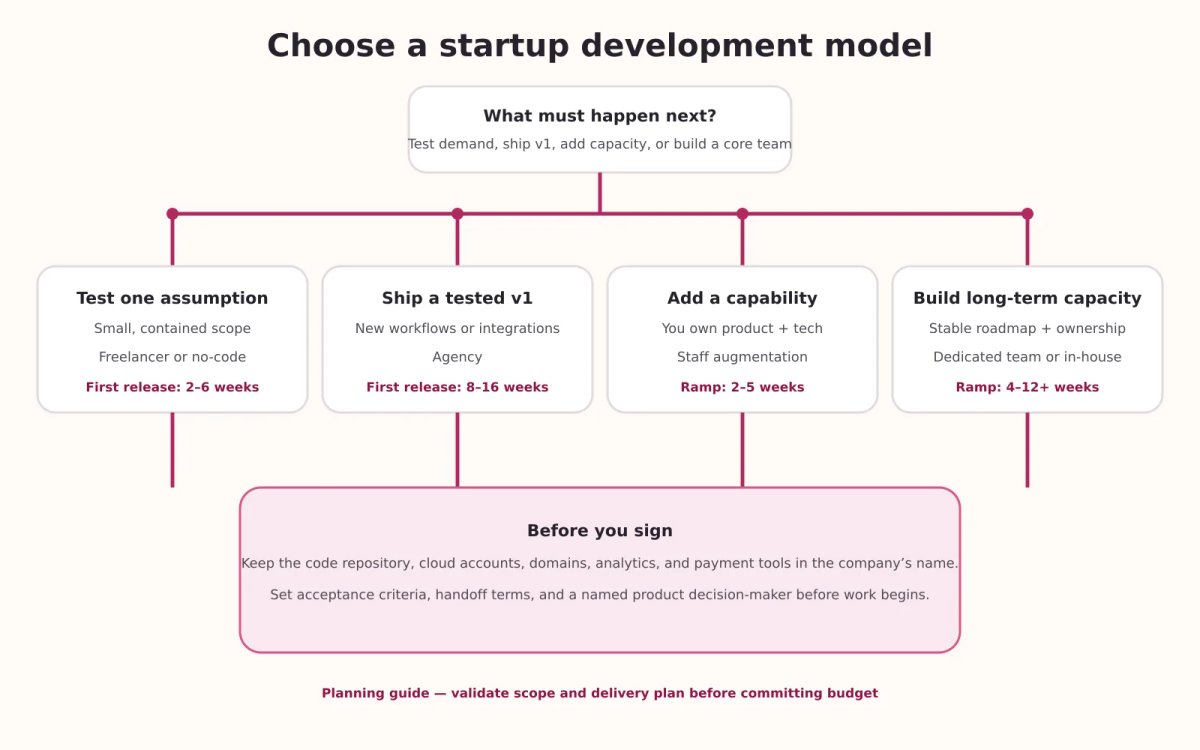
Choose the smallest model that can produce the next business proof point without creating a handoff problem. A founder testing demand needs a different setup than a team with paying users and a stable roadmap. Decide first who owns product, technical, and release decisions; then buy the capacity around that ownership.
Before choosing a model, answer these questions in writing:
- What is the riskiest assumption: demand, usability, technical feasibility, data quality, compliance, distribution, or unit economics?
- What must be true within the next 90 days for this build to be worth the spend?
- Which parts of the product create defensible company knowledge?
- Which parts are standard execution, such as payments, admin panels, integrations, QA, or deployment?
- Who will own product decisions every week?
- How fast can the team get access to users, support tickets, analytics, and operational feedback?
- What technical debt is acceptable for this stage, and what debt would block the next round or next customer segment?
- What happens if the first version works and usage doubles?
- What happens if the first version fails and you need to change direction?
- Who owns the code, infrastructure, credentials, documentation, and release process?
Choose a freelancer when the work is narrow, the scope can be described clearly, and failure would not damage the company. This is a good fit for prototypes, small automations, design-to-code work, or contained integrations.
Choose an agency when you need a coordinated team to ship a tested v1, especially if the product has multiple roles, workflows, integrations, or quality requirements. This is often the strongest route for funded startups that need delivery speed before internal hiring catches up.
Choose in-house when product learning is becoming your operating advantage. If your team is releasing weekly, learning from users, and making technical tradeoffs that affect the business model, core engineering should move inside.
Choose a dedicated or hybrid team when the product direction is clear enough to scale delivery, but hiring every role would slow the roadmap. This works best when the startup already has product leadership, architecture ownership, and a release process.
The most expensive model is the one that hides learning. A cheap build with no users, no tests, no deployment discipline, and no handoff plan is not cheap. A higher-cost build that proves a sales motion, supports real operations, and leaves the company with usable code can be the better business decision.