
An aggregator business model brings a fragmented supply market under one customer-facing brand. The aggregator sets a consistent experience, usually controls the price and payment flow, owns the customer relationship, and earns through a commission, fee, subscription, advertising, or a mix of those mechanisms.
That definition separates an aggregator from a marketplace. A marketplace helps independent sellers meet buyers; an aggregator makes the service feel like one company is delivering it. The distinction affects your operating costs, technical architecture, legal exposure, and ability to control quality.
Key takeaways
- An aggregator owns the promise made to the buyer, even when a supply partner performs the work.
- Standardisation can lift trust and repeat use, but it creates expensive quality-control and compliance duties.
- The strongest fit is a fragmented supply category where customers value a reliable, branded outcome over choosing a specific seller.
- An aggregator platform needs live supply data, matching or dispatch logic, payments, ratings, and an operations console from the first release.
What is an aggregator business model
An aggregator business model is a platform model in which one brand bundles comparable services or products from multiple supply partners and sells a standardised experience to the customer. The aggregator normally sets customer-facing rules and is accountable when service quality fails.
Three conditions make the model real. The buyer sees one brand, not a shelf of independent sellers. The offer follows a standard service level or product promise. The aggregator controls the customer relationship, including support, payment, refunds, and usually the price. That is the plain answer to "what is an aggregator in business?"
How aggregators differ from marketplaces, directories and resellers
Business structure matters because it decides who takes the complaint, who bears pricing risk, and what software you need. A marketplace platform development project should start with this choice, rather than treating an aggregator as a marketplace with different labels.
| Model | Buyer sees | Who sets price | Customer relationship | Inventory ownership | Quality liability | Main revenue | Example |
|---|---|---|---|---|---|---|---|
| Aggregator | One brand | Aggregator | Aggregator | Usually none | Aggregator | Take rate or fee | Uber |
| Marketplace | Many sellers | Seller or platform | Shared | Usually none | Seller and platform | Commission | Etsy |
| Directory | Listings | Supplier | Supplier | None | Supplier | Listing fee | Yelp |
| Reseller | One seller | Reseller | Reseller | Often owns | Reseller | Markup | Retailer |
Price-comparison products sit closer to directories than aggregators when they send a buyer away to complete the purchase. See how to build a price comparison website before treating search and referral revenue as an operations-heavy platform business.
How the model evolved
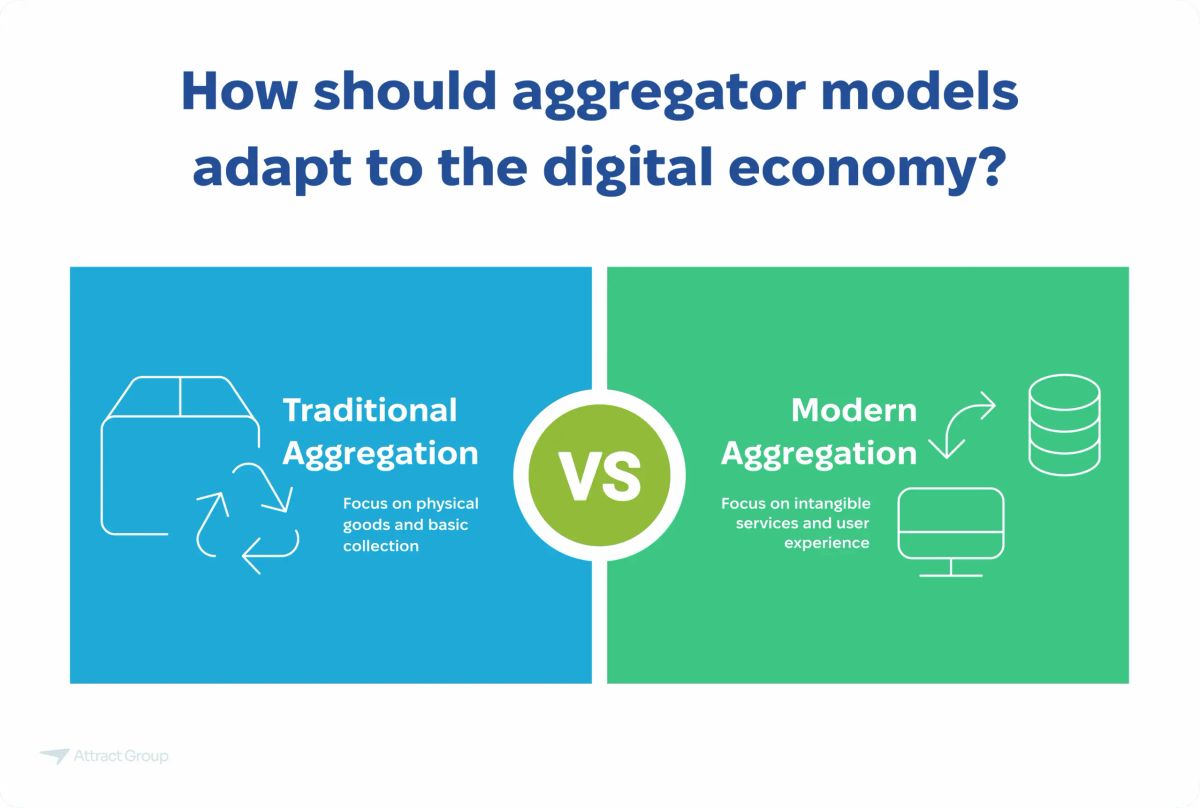
Early aggregators mainly collected information: flight fares, news, product offers, and listings. Mobile payments, location services, and real-time matching turned the model into an operating layer for rides, delivery, home services, and bookings. That shift increased control over the customer experience, but it also moved more liability and support work to the platform.
Types of aggregator business models
Aggregator types differ mainly in what they standardise and how quickly supply availability changes. The operating model for an on-demand service is very different from a product catalogue, even if both collect a commission.
| Type | What is aggregated | Examples | Primary revenue | Main operational challenge |
|---|---|---|---|---|
| Service aggregator | Local providers | Uber, Urban Company | Commission and fees | Dispatch and quality |
| Product aggregator | Catalogues or stock | Instacart | Margin or commission | Inventory accuracy |
| Information aggregator | Prices or content | Skyscanner | Referral or ads | Data freshness |
| Payment aggregator | Merchant payment flows | Stripe | Processing fee | Risk and compliance |
Service aggregators
Service aggregators coordinate people who deliver a comparable service under the platform's rules. Ride-hailing, cleaning, repairs, and care services need availability, geographic matching, service-level rules, ratings, dispute handling, and fast support. The partner may be independent, but the customer judges the platform.
Product aggregators
Product aggregators combine merchant inventory into one buying journey. They need product normalisation, tax and delivery rules, substitution logic, and reliable inventory updates. That scope sits within e-commerce development, although B2B implementations also need account pricing, approvals, and ERP integration. Those are covered in our guide to B2B ecommerce platforms.
Information and payment aggregators
Information aggregators help users compare options while the supplier often completes the transaction. Payment aggregators abstract card networks and banking rails for merchants. A payment aggregator business model earns a processing fee, but its core work is underwriting, fraud controls, reconciliation, and regulation, not merely collecting payment methods.
How aggregator platforms make money
An aggregator makes money by charging for access, transaction flow, visibility, or software. The best revenue model is one that leaves supply partners enough margin to stay active after promotions stop.
Public companies rarely disclose a clean, universal commission rate. The ranges below are planning estimates based on reported revenue and gross booking figures from Uber and other platform disclosures, not a promise of unit economics for a new business.
| Revenue model | How it works | Typical range | Best suited to | Risk |
|---|---|---|---|---|
| Transaction commission | Share of order value | 10-30% estimate | On-demand services | Partner churn |
| Customer service fee | Flat or percentage fee | 1-15% estimate | Delivery and booking | Price sensitivity |
| Subscription | Recurring access fee | Fixed monthly fee | Frequent buyers | Weak usage |
| Premium placement | Paid ranking or promotion | Variable | Catalogues and listings | Trust erosion |
| Payment processing | Fee per transaction | 2-4% estimate | Merchant platforms | Fraud loss |
A high take rate can fund dispatch, customer support, insurance, refunds, and acquisition. It can also make your best supply partners leave once they have enough direct demand. Test partner economics with real job costs, cancellation rates, and promotion spend before setting a public commission.
Model the economics before you build
We can map take rate, partner costs, payments, and the platform scope required for a viable aggregator launch.
How the aggregator model works operationally
An aggregator platform works when the customer journey and the supply-partner workflow use the same live operational data. A polished checkout cannot compensate for stale availability, delayed dispatch, or a support team that cannot see what happened to an order.
Technology requirements
The baseline stack includes a customer app or website, partner tools, an admin console, payment orchestration, notifications, ratings, and reporting. Real-time inventory or availability, matching and dispatch, cancellation rules, and refund handling belong in the first usable release. An ecommerce analytics stack should connect orders, fulfilment events, acquisition cost, and refunds, or the team will optimise activity instead of contribution margin.
Supply acquisition and partner economics
Recruit supply before spending heavily on demand. Start with one narrow geography or category, define the service standard, test partner onboarding, and agree who pays for refunds, failed fulfilment, and promotions. Supply density matters: a customer who cannot find a viable option at the moment of need will not care how good the app looks.
Demand acquisition and retention
Early demand should be targeted at a use case with a measurable repeat trigger, such as weekly delivery, urgent repair, recurring bookings, or business procurement. Track first order, repeat order, cancellation, fulfilment time, refund rate, and supply acceptance by area. Those metrics expose whether the problem is marketing, liquidity, quality, or pricing.
Build the operating layer, not just the interface
Talk to a product team about matching, payments, partner tools, and the systems that keep the service reliable.
Advantages and trade-offs of the aggregator model
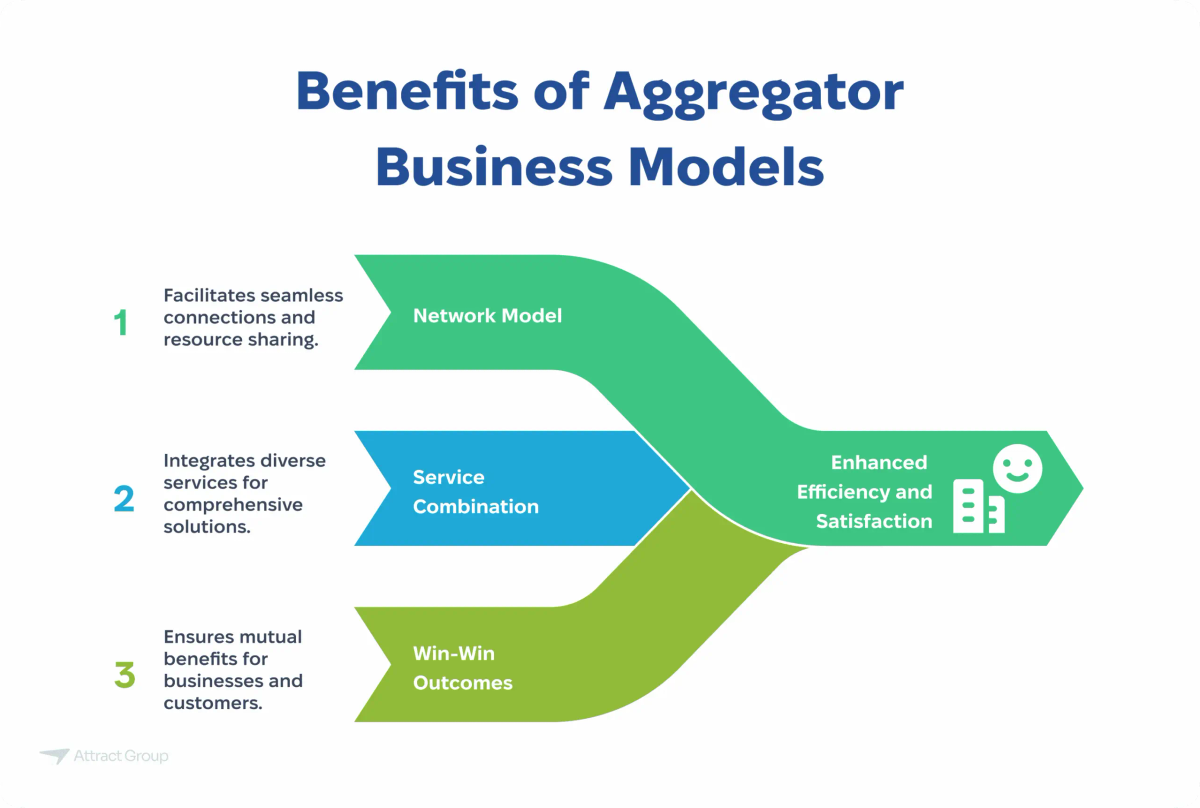
The aggregator model can scale supply without owning all assets, but it does not avoid operations. It relocates operations into contracts, data, support, quality assurance, and exception management.
| Dimension | In the aggregator's favour | What works against it |
|---|---|---|
| Scalability | Asset-light supply expansion | Density needed by area |
| Margin | Fees on each completed order | Promotions and support cost |
| Loyalty | One familiar customer experience | Direct supplier alternatives |
| Quality control | Platform rules and ratings | Uneven partner delivery |
| Regulation | Central policy enforcement | Platform may inherit liability |
| Supply dependence | Broad partner network | Partners can multi-home |
Quality control is the hard part. Standardise onboarding, service rules, evidence for disputes, refund authority, and partner performance thresholds before growth makes exceptions unmanageable.
Aggregator business model examples
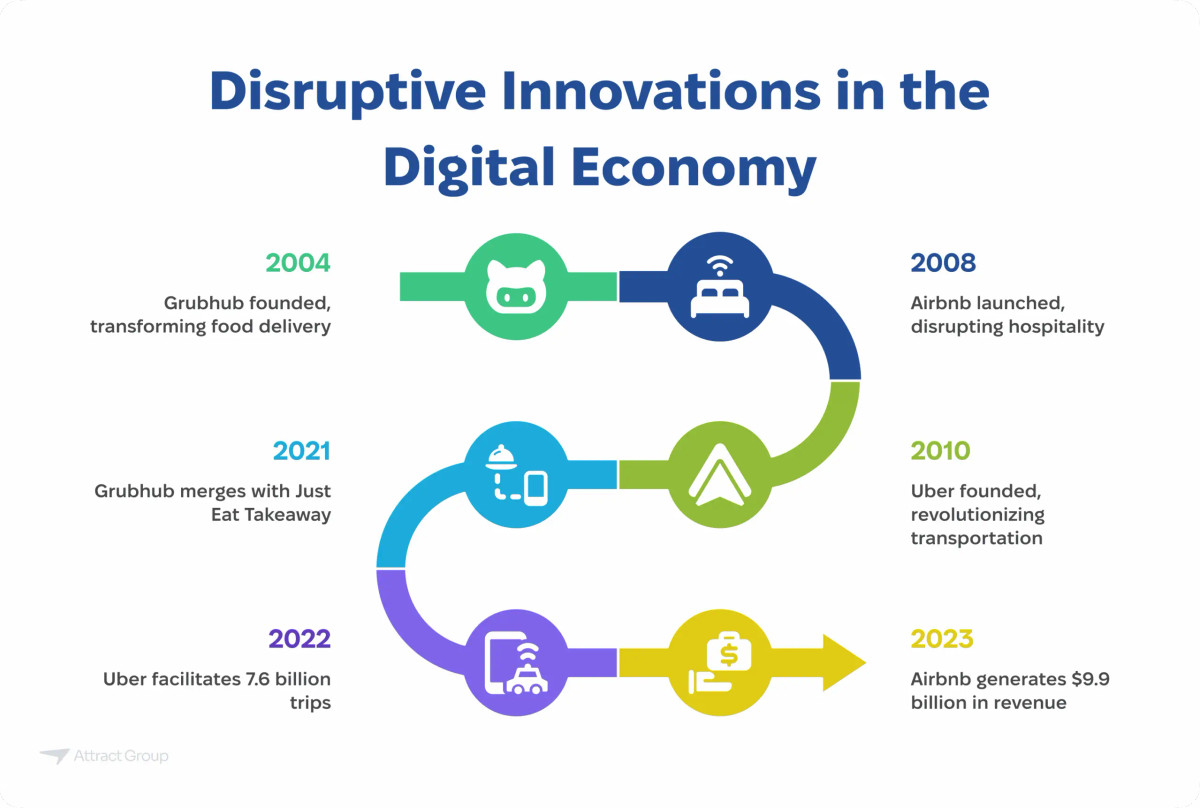
The best aggregator business model examples show different degrees of platform control. Uber standardises matching and payment for local transport; Airbnb gives hosts more pricing autonomy, which makes it closer to a marketplace in practice; food delivery platforms combine restaurant supply with a customer-facing fulfilment layer.
| Company | Launched | What it aggregates | Current scale | Latest reported revenue | Source |
|---|---|---|---|---|---|
| Uber | 2009 | Drivers and delivery partners | 171m MAPCs, Q4 2024 | $43.98bn, 2024 | Uber results |
| Airbnb | 2008 | Hosts and stays | 8m active listings, 2024 | $11.1bn, 2024 | Airbnb 2024 results |
| Grubhub | 2004 | Restaurants and diners | Sold to Wonder in 2025 | Parent revenue €5.1bn, 2024 | JET results |
| Meituan | 2010 | Local merchants and consumers | China local-services platform | RMB337.6bn, 2024 | Meituan results |
The reported figures above come from Uber's 2024 results, Airbnb's investor reporting, Just Eat Takeaway.com's 2024 results, and Meituan's 2024 annual results.
Uber is usually called an aggregator because it sets much of the rider experience, manages payment, and governs driver participation. Airbnb is a useful counterexample: it aggregates accommodation supply but hosts retain substantial control over price and the stay. Meituan shows that the model can extend beyond a US ride-hailing pattern into food, retail, travel, and local services under one consumer product.
Should you build an aggregator or a marketplace
Choose an aggregator when your company can credibly standardise the outcome and accept responsibility for the customer promise. Choose a marketplace when buyer choice, seller identity, and flexible pricing are the product.
| Your situation | Better fit | Why |
|---|---|---|
| You can guarantee quality | Aggregator | One service standard builds trust |
| Supply is fragmented | Either | Depends on control and density |
| Buyers choose a seller | Marketplace | Seller identity drives choice |
| You need to set price | Aggregator | Central pricing supports consistency |
| Regulatory exposure is high | Marketplace or phased model | Liability needs careful allocation |
| You need rapid category breadth | Marketplace | Sellers can manage their offers |
The common mistake is launching as an aggregator before the business can fund quality control and support. A marketplace model can validate demand first, then add managed supply in categories where buyers value standardisation.
Choose the right platform model first
We help founders test whether an aggregator or marketplace fits their supply, customer, and operating constraints.
How to launch an aggregator platform
Launch with a narrow use case, a small supply network, and a measurable service promise. A broad catalogue before you can reliably fulfil one use case creates expensive churn on both sides of the platform.
- Pick one category, geography, and customer trigger. Define the service promise in operational terms: response time, availability, cancellation policy, and refund rules.
- Sign enough supply partners to make the first customer request viable. Test onboarding, availability updates, payments, and support before broad acquisition.
- Build the MVP around the critical transaction: discover, match, pay, fulfil, rate, and resolve exceptions. MVP development should reduce uncertainty, not copy every feature from an established platform.
- Run a controlled launch, review fulfilment and partner economics weekly, and expand only when repeat demand and service quality hold in the initial segment.
Conclusion
An aggregator business model works when you can create a more reliable customer experience than fragmented suppliers can provide alone. Start with a narrow category, verify supply economics, and build the operational controls before expanding demand. If buyers need choice more than standardisation, a marketplace may be the cheaper and safer first move.