We build two sided platforms, and then keep building them. One of ours ran for seven years.
Marketplaces are easy to launch and hard to keep alive. The platform part is mostly solved work: catalogues, accounts, payments, payouts. What decides whether the business survives is supply that shows up, a catalogue buyers can actually compare, and enough reason for both sides to keep transacting on your platform instead of around it. We build for that, and we will tell you when a marketplace is the wrong shape for your market.
Multi-vendor, service, on-demand and B2B trading platforms with catalogues, payouts and operator tooling built in.
Fit
Is this you?
01
You have a fragmented market
Supply and demand both exist and cannot find each other efficiently. You need liquidity before you need features.
02
You already have one side
Customers or suppliers, and opening the platform to third parties would widen the catalogue without widening your operation.
03
You run a service or on-demand business
The product is somebody's time and a calendar, so booking, dispatch, cancellation and payment are the platform.
04
Your marketplace has outgrown its platform
It works, it is stuck, and every change costs more than the last one.
Types
Types of marketplace we build
The type decides the architecture, so we settle it first.
01
Multi vendor retail
Many sellers, one catalogue, one checkout, split payouts, shipping and returns per seller.
02
Service and on-demand
Providers, availability, booking, dispatch, cancellation rules, payment held and released after delivery.
03
Rental and time based
Inventory that comes back, deposits, damage, overlapping bookings.
04
B2B trading and procurement
Negotiated prices, tenders, verified sellers, payment terms, stock read from an ERP.
05
Aggregators
Supply pulled from many sources and normalised into one catalogue a buyer can compare.
Core problems
The four problems every marketplace has to solve
None of them is a feature, and all four have cost our clients more thought than the technology did.
01
Liquidity
An empty marketplace has nothing to show either side. Version one has to let you seed supply by hand, onboard sellers in bulk instead of one at a time, and look credible with ten sellers rather than a thousand.
02
Comparability
Different sellers describe the same thing differently, filters return nothing, and the platform looks empty when it is not. A shared vocabulary your team maintains without a developer is core work, not admin.
03
Trust
Verification before a seller can trade, moderation, reviews only from buyers who actually bought, and a way to handle disputes. In most markets this is what makes a stranger transact.
04
Leakage
Both sides can meet on your platform and do the deal somewhere else. Keeping the transaction inside touches identity, messaging, quoting and payment, and it decides whether you have a business or a directory.
Scope
What goes into a marketplace build
A marketplace is three products sharing one database, and the third one is the one people underestimate.
01
Buyers
Search across every seller, profiles and reviews, booking or cart and checkout, order and delivery tracking, saved lists and repeat orders, and messaging.
02
Sellers
Onboarding with verification, catalogue or availability management including bulk upload with a review step before anything goes live, order handling, payouts and balances, and a view of how they are performing.
03
You, the operator
The console that makes the business runnable: approvals and moderation queues, commission settings, the shared vocabulary, money movement and reporting, dispute handling, and the ability to edit content and translations without a release.
Across all of it: several currencies and languages, payments and payouts, notifications, reporting, and mobile apps where the market is mobile first.
Work
Marketplaces we have built
Curbside Kitchen
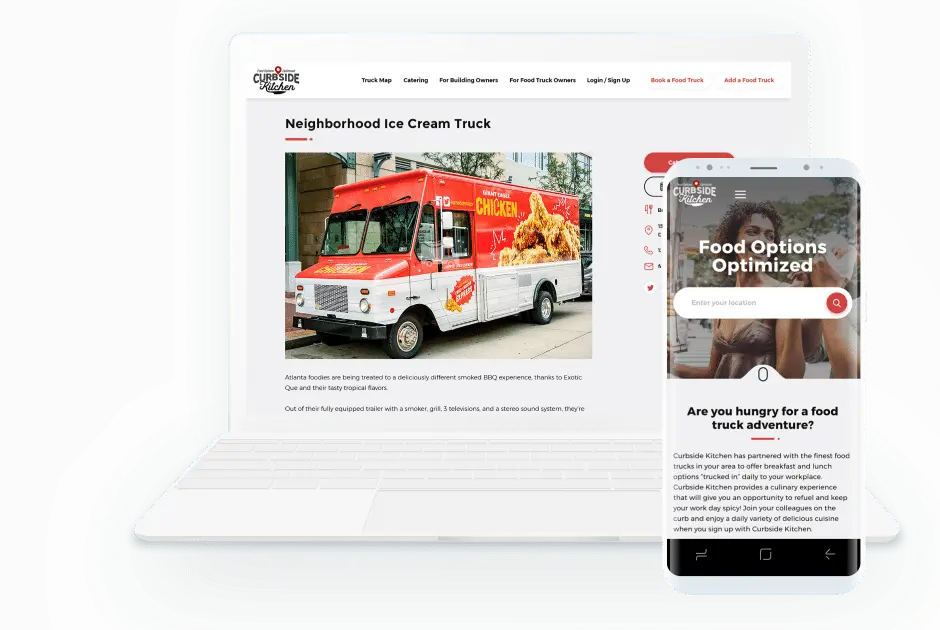
Curbside Kitchen matches food trucks with offices and venues in the United States. We built it and then developed it with the client from September 2017 to November 2024. Seven years, in a category where plenty of platforms never see a second one.
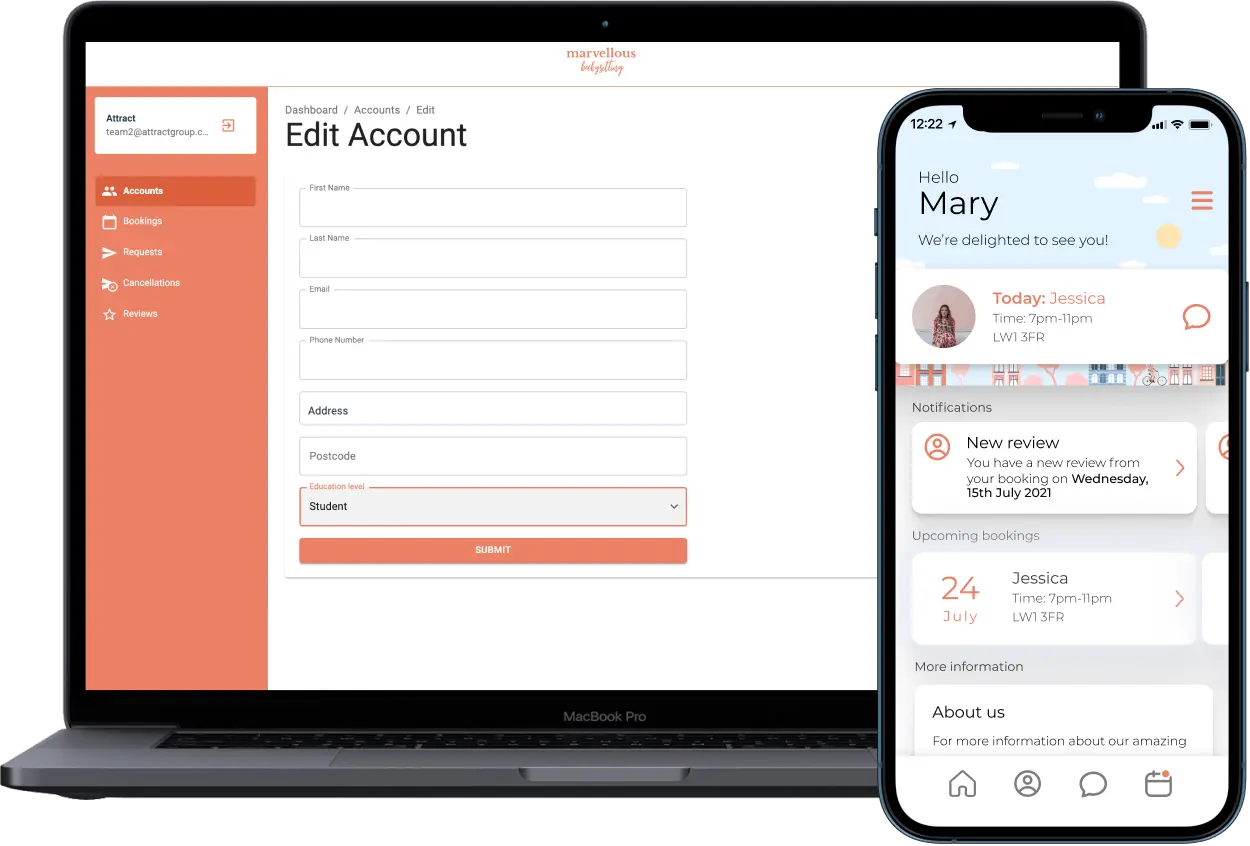
Marvellous is an on-demand nanny booking marketplace in the UK, with profiles, chat, reviews, matching and admin tooling for parents and certified caregivers.
Projects start with us from $10,000 for discovery and a defined model.
Engagement
Range
Duration
Discovery and model definition
from $10,000
2 to 3 weeks
First working version
$30,000 to $70,000
3 to 4 months
Marketplace with negotiated pricing, wallets or tenders
$120,000 to $250,000+
6 to 12 months
Continuous development
from $4,000 per month
ongoing
What moves the number: how many sides and roles, whether money moves through the platform and how payouts split, booking and availability rules, mobile apps or web only, how many external systems have to agree, and how much your team moderates.
Deciding what to build should cost less than building it, which is why the first number is small.
Process
How the work runs
2 to 3 weeks
Discovery and model
The model on paper, the vocabulary, the money flow, a scope for version one and a fixed price for it
3 to 4 months
Version one
A working platform with both sides and the operator console, enough to run real transactions
2 to 4 months
Liquidity and hardening
Onboarding at volume, moderation tooling, reporting
Ongoing
Continuous development
Roadmap work at a fixed monthly capacity
Version one leaves things out on purpose. We tell you which, and why, before you sign.
“Attract Group's efforts resulted in a bug-free app that beta users could easily navigate. The team provided frequent updates on their progress and was highly accommodating throughout the engagement. Attract Group was organized and responsive.”
“Attract Group provides outstaffing services for a fintech company. They take the time to better understand our requirements and provide the best options. Attract Group delivers on time, and their communication is quick.”
“Attract Group has deployed top-notch professionals who manage the project efficiently and ensure timely delivery of outputs. They also impress us with their transparency in their technical skills and business consulting values.”
01–03 / 06 CURATED · 39 TOTAL ON CLUTCH
Next step
Start with discovery
Two to three weeks, a fixed price, and a document that says what the model is, what version one contains and what it costs. Useful even if you build it with someone else.
From $10,000 for discovery and a defined model. A first working version usually runs $30,000 to $70,000 over three to four months. Negotiated pricing, wallets or complex payout splits push it higher.
How do we solve the empty marketplace problem?+
Version one is built so you can seed supply yourself, onboard sellers in bulk, and look credible with a handful of them. Liquidity is a commercial problem, but the platform makes it either easier or much harder.
Do we need a mobile app as well?+
Only if your market is mobile first. On-demand and booking marketplaces usually are. Procurement marketplaces usually are not. Responsive web first, apps when usage justifies them, is the cheaper order.
How do commission and payouts work?+
A take rate per transaction, balances held in the platform with cash-outs your team approves, or direct payouts against each seller's share. Split payments across several sellers in one order are normal and we have shipped them.
Can you take over a marketplace somebody else built?+
Yes, and most of our long engagements started that way. We begin with an audit that says plainly whether to extend it or replace it in stages.
How do you stop buyers and sellers taking deals off the platform?+
By design rather than by policy. Messaging, quoting and payment run inside the platform, and the transaction record carries enough value in documents, history, ratings and dispute cover that leaving costs both sides something.
Which technology do you use?+
For a bespoke build, our marketplace and commerce work runs on Laravel or Django with a React or Vue front end, PostgreSQL or MySQL, and a separate service for anything real time. If a platform fits your model better, we will say so on the first call.
Will we own the code?+
Yes. Code, repository, documentation, environments, and a defined exit, from day one.
Get a build estimate
Tell us which sides you already have, how money should move, and whether the market is mobile first. We will reply with a clear next step and a fixed-price discovery scope.