
We engineer software around how your operation actually works.
SAP ECC replacement services
S/4HANA isn't your only option
SAP ends mainstream maintenance for ECC at the end of 2027. Before you sign a multi-year S/4HANA project, we map what your ECC really does, price each way forward over five years, and help you move at a pace your plant can handle.
The 2027 deadline
What changes after 2027, and what doesn't
Your system won't switch off on January 1, 2028. It will keep running. What changes is who fixes it and how much that costs.
The bigger risks are quieter. None of them forces a big-bang project, but together they mean you need a plan.
Security patches thin out
Fixes slow down while the system keeps carrying your orders, stock and money.
Know-how walks out
The people who understand your custom code retire or move on.
Every new tool gets harder
Each new tool you want to connect has to talk to a system that's getting older.
Your options
Four ways forward from ECC
Most ERP replacement services start from the answer they sell. This table starts from your situation. We fill it in with your real numbers during the options review.
| Criteria | Stay on ECC with paid support | Move to S/4HANA | Switch to another ERP | Modernize around ECC |
|---|---|---|---|---|
| What you're paying for | Time, plus a growing support fee | Licenses, a systems integrator and a long project | A new license, data migration and retraining | Custom apps for the workflows that hurt, built in stages |
| Disruption to the plant | Low now, rising later | High, often spread over several years | High at cutover | Low, one workflow at a time |
| Lock-in | Same as today | Deeper, especially on a cloud subscription | Moves to a new vendor | Lower: the new parts are yours, on open APIs |
| Makes sense when | ECC still fits and the plan is to exit later | SAP is core to how the group runs | ECC no longer fits and a package does | ECC handles finance fine, but production, quoting or customer work happens around it |
We don't sell S/4HANA licenses and we aren't an SAP implementation partner. That lets us be blunt about which column fits you.
Our approach
Legacy ERP modernization services, one workflow at a time
We connect your existing systems and build the missing pieces. For ECC, that means taking the work your teams do around SAP and giving it a proper home.
Each piece runs on documented APIs. Over time ECC shrinks to the jobs it still does well, often finance and purchasing. When you decide to replace the core, most of the hard workflows have already moved, and the final switch is smaller and cheaper.
Production & MESShop-floor scheduling and job tracking move into an MES that reads work orders from ECC.Quoting & configurationQuotes and configurations get their own tool and land in ECC as clean sales orders.Dealer & B2B portalsDealers and customers order and check status in a portal instead of calling your office.Reporting data layerReports come from a separate data layer, so nobody waits on an ABAP developer for a new view.
Options review
Start by finding out what's really in your ECC
After 10 or 15 years, most ECC systems carry custom Z-programs and interfaces that nobody fully remembers. Some still matter. Some stopped mattering years ago.
Any ERP modernization services engagement with us opens with an inventory, so you decide with facts instead of a sales deck.
Get a 2027 options reviewWhat you get at the end of the review
usually 2 to 4 weeks01A map of custom code, reports and interfaces, with who uses each one
02A keep, rebuild or retire decision for every item
03A five-year cost estimate for each of the four options
04The first workflow we'd move off ECC, and why that one
Proof
We've built around systems that stay
The system of record keeps doing its job. The new product sits on top, reads from it and writes back to it.
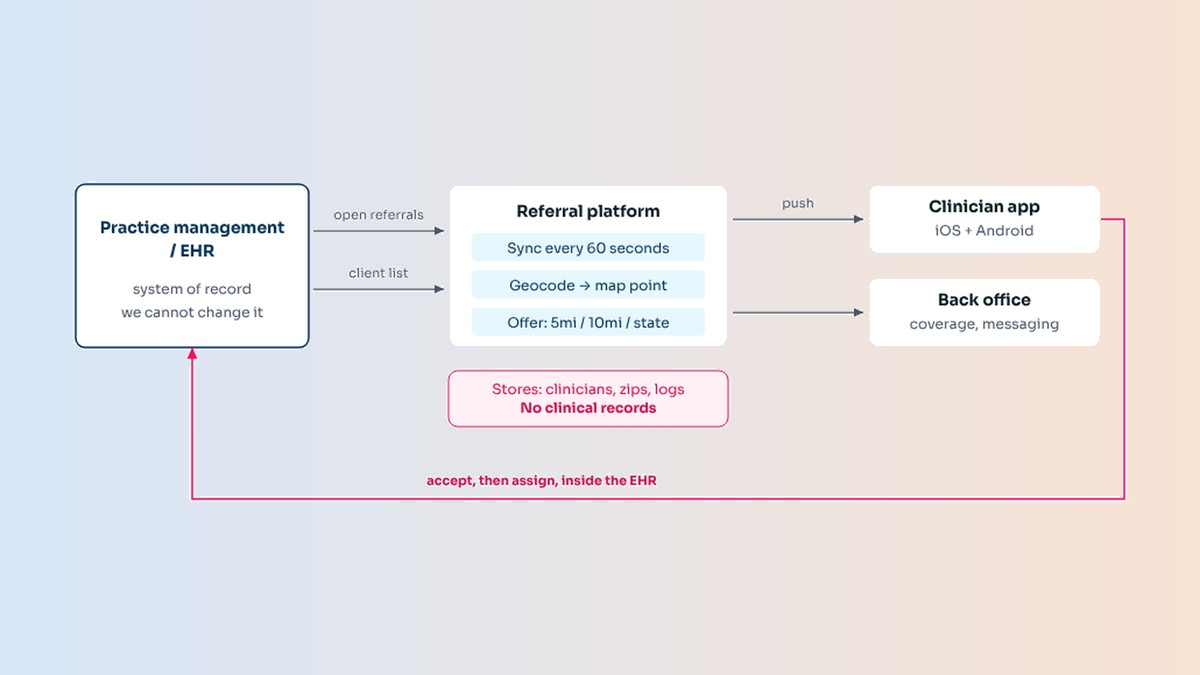 Healthcare · built on top of a system that stays
EHR Layer
The practice couldn't replace its EHR or copy patient data out of it. We built an app that reads referrals from the EHR every minute and writes accepted cases back.
View case study CRM/ERP · up to 75% less idle time
Jira-like CRM/ERP
The old internal CRM stopped covering reporting and planning. We built an on-premises CRM/ERP that automates reports and workload allocation.
View case studyProcess
How the work runs
- 01Options reviewInventory, interviews with finance, production and IT, and the cost comparison.
- 02DecisionYou pick the path. If it's S/4HANA with an SAP partner, we hand over the inventory and step back.
- 03First workflowWe build and launch the first custom piece next to ECC, on real orders.
- 04Staged movesMore workflows follow, each with its own scope and cost agreed before work starts.
- 05SupportWe keep the new systems running and adapt them as the business changes.
- You see working software at each stage.
- AI helps us read legacy code and write tests. A person signs off every line.
- You own the code and documentation we produce.
Fit
Who this is for
A good fit for manufacturers and distributors that:
run ECC at one or more plants, often with heavy customization
use SAP mainly for finance and purchasing, while production, quoting or customer service lean on spreadsheets and side tools
want to control cost and disruption instead of signing a single multi-year program
The wrong fit if:
you've already chosen S/4HANA and need a certified SAP implementation partner. In that case we're happy to point you to one.
FAQ
SAP ECC questions from manufacturers
What happens to ECC after 2027?
It keeps running. Mainstream maintenance ends, and paid extended maintenance runs to 2030. After that you rely on customer-specific maintenance or a third-party support provider. The day-to-day risk grows slowly, which is why so many companies put the decision off.
Is extended maintenance cheaper than migrating now?
For a year or two, usually yes. Over five years it depends on how much custom code you carry and how much work already happens outside SAP. The options review puts both paths side by side with your numbers.
Can we modernize around ECC before replacing it?
Yes, and for many mid-sized manufacturers it's the safest route. Production, quoting and customer workflows move into custom apps first. The core ERP decision comes later, with less riding on it.
How do you find undocumented Z-code and interfaces?
We read the system itself: custom objects, transaction usage logs, interface configs and batch jobs. Then we check what we found with the people who use it. The result is a list you can act on.
Brownfield, greenfield, or a different ERP?
Brownfield keeps your processes and your technical debt. Greenfield cleans both up and costs more up front. A different ERP makes sense when SAP no longer fits how you work. Your own numbers usually point clearly to one of them, and sometimes that one is S/4HANA.
Do you offer ERP migration services to S/4HANA?
We don't implement S/4HANA. We prepare the move: inventory, data cleanup, custom workflows rebuilt outside SAP. A certified partner then handles the S/4 project, which usually ends up smaller.
Is this realistic for a company our size?
The step-by-step approach was built for companies that can't stop the plant for a two-year project. Each stage has its own scope and budget, so you can pause between stages if you need to.
What would you keep from ECC if you started over?
That question usually tells us more than any requirements document. Book an options review, and we'll show you what each path out of ECC costs for your business. You leave with a keep, rebuild or retire map, a five-year cost for each option, and the first workflow to move off ECC.
Or call us directly:+1 888-438-4988