
Inventory management software development for multichannel retailers
Shopify says 12. Amazon says 9. The store says 4. Your 3PL says 15. As an inventory management software development company, we build the software that decides which number is true and updates every channel at once.
We don't sell an off-the-shelf inventory product. We develop inventory, order management and POS software around your channels, locations and rules. We connect your existing systems and build the missing pieces.
15+
years in business
100+
systems delivered
5+ yrs
avg. client relationship
Peak season
How a good sales day turns into a bad weekend
- 01
A promotion goes live on Friday morning. Orders come in from the website, Amazon and two stores.
- 02
Stock levels sync between systems every few minutes. During peak traffic that gap is long enough to sell the same unit twice.
- 03
By Saturday you've sold 30 units you don't have.
- 04
Customer service spends the weekend cancelling orders and apologizing.
- 05
On Monday someone raises the safety buffer, and now items show as out of stock while they sit on the shelf.
Nightly CSV files and manual allocation between channels keep things going for a while. They stop working when you add a channel, a store or a 3PL.
Source of truth
One stock number every channel trusts
We develop an inventory core that sits between your sales channels and the places where stock lives. Every sale, return and stock transfer updates it first. Channels read from it instead of from each other.
Your team decides the rules: how much of each item each channel may sell, which warehouse fulfils which order, and what happens when stock runs low.
Features
Custom inventory management software: features we develop
| Feature | What it does for your team |
|---|---|
| Real-time stock tracking | Stock levels per SKU, per location and per channel, updated with every sale, return and transfer. |
| Available-to-sell rules | Real stock minus reservations, open orders and channel buffers. |
| Multi-location stock | Warehouses, stores and 3PLs in one view, with transfers between them. |
| Purchase orders and suppliers | Create POs, track supplier deliveries and receive stock against them. |
| Reorder points and replenishment | Alerts or draft POs when stock drops below the level you set. |
| Bundles and kits | Selling a bundle reduces each component; a missing component pauses the bundle. |
| Barcode scanning and RFID | Receiving, counts and transfers with scanners your staff already use. |
| Lot, batch and expiry tracking | For products where batches or dates matter. |
| Cycle counts and audits | Counts by zone or SKU, with differences sent for review. |
| Returns | Stock goes back to the right place with the right status. |
Orders
Custom order management system development
We build order management software that routes each order to the right warehouse, store or 3PL, splits orders when needed, and tracks every step to fulfillment. Store pickup, ship-from-store and backorders follow your rules. Customer service sees the full order history in one place.
Stores
POS software development services for your stores
If your stores run a separate POS, store stock and online stock drift apart. Our POS software development services connect store sales to the same inventory core as online orders. Store staff can check stock at other locations, reserve items for pickup and accept online returns at the till.
When an off-the-shelf POS doesn't fit your store process, we do custom POS software development: checkout screens, payments, mobile POS for the shop floor, offline mode for poor connections, and sales reporting across outlets. Often a smaller step is enough, and we keep your POS and connect it properly. Shared customer data can also feed loyalty and customer apps.
Failure handling
When a sync fails, you know before customers do
Every integration fails sometimes. An API times out, a webhook gets lost, a file arrives late. What matters is what happens next.
- Failed updates are retried automatically and logged.
- Anything still wrong after retries lands in an exception queue with the order or SKU attached.
- If a channel goes quiet for too long, the software lowers what it can sell there until the connection is back.
- Every stock change has a record of who or what made it.
Rollout
Switching over without a risky cutover
Nobody wants to replace inventory logic right before peak season. So we roll out in steps:
- 01Shadow modeThe new inventory core runs next to your current setup and calculates stock without changing anything.
- 02CompareFor a few weeks we check its numbers against your systems and fix the gaps.
- 03One channel firstThe lowest-risk channel switches over.
- 04The restOther channels follow once the first one runs clean.
Proof
Retail systems we've built
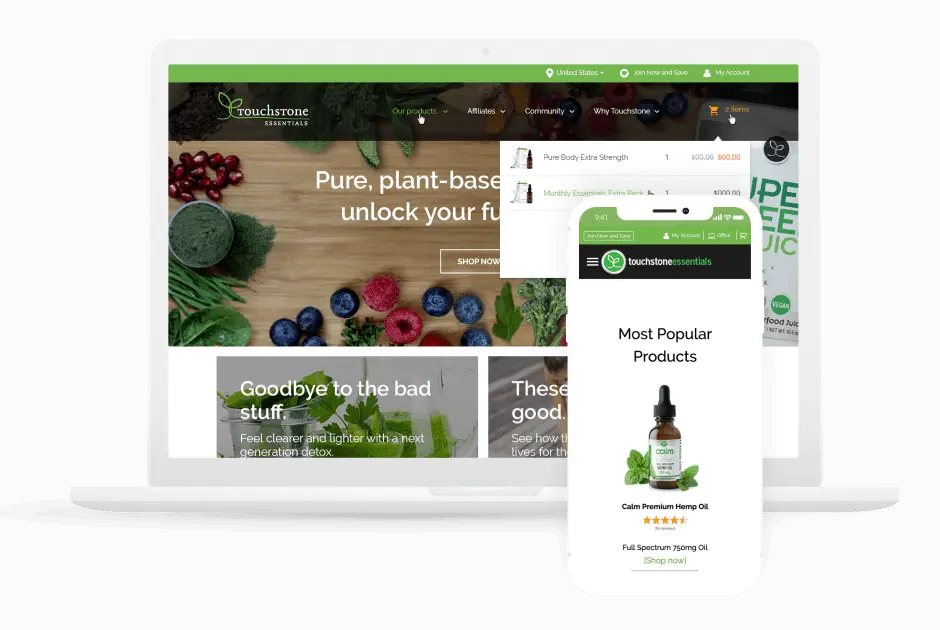
Supplements ecommerce · autoship and order rules
Touchstone Essentials
Supplements store with autoship, role-based pricing and referral shops — order logic that has to stay consistent as volume grows.
View case study →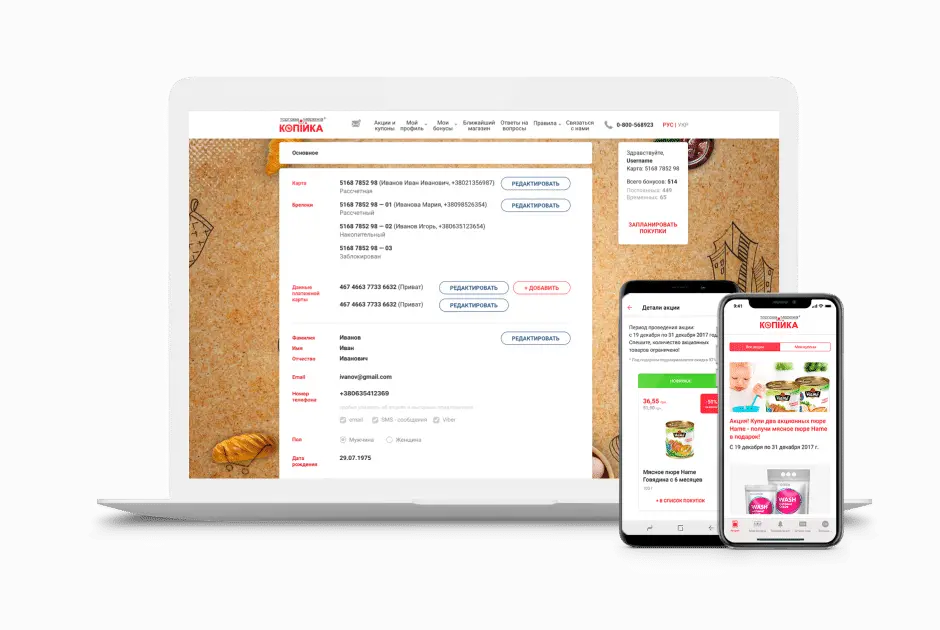
Retail loyalty · CRM-connected retail systems
Kopiika
Retail loyalty platform with CRM sync and customer apps — purchases and promotions stay connected across the chain’s systems.
View case study →Planning
Forecasting, replenishment and reporting
We build demand forecasting on your own sales history, seasonality and promotions, so buyers see what to reorder before stockouts or overstock happen. Where it helps, we use machine learning for forecasts and anomaly alerts, and simple rules where those work better. Dashboards show stock value, sell-through, slow movers and channel performance without exporting to a spreadsheet.
Integrations
Integrations with the systems you already run
Inventory management software development is mostly integration work. We connect your ecommerce platform (Shopify, BigCommerce, WooCommerce), marketplaces such as Amazon and Walmart, POS systems, ERP and accounting software, warehouses and 3PLs, and shipping carriers. Each connection has monitoring, so a broken sync shows up as an alert.
Stack
Technologies, cloud or on-premise
We build with common, well-supported technologies, so another team could maintain the code later: Node.js, Python or PHP/Laravel for services, React for admin screens, PostgreSQL, and message queues for event-based stock updates. Most retail clients run in the cloud (AWS or Google Cloud). On-premise or hybrid setups are possible when your stores or ERP need them.
Cost
Cost and timeline
The budget depends on the number of channels and locations, how many systems we connect, and whether POS is part of the scope. We work as an inventory management software development company that prices the job you have, not a package. After the stock flow review you get an estimate for your case. Scope and cost are agreed before each stage starts, and you see working software along the way.
After launch
Security, support and ways to work with us
Access is set by role, data is encrypted in transit and at rest, and every change is logged. After launch we monitor syncs, fix issues and adapt the software as you add channels or locations. AI helps us build and test faster; the quality of the result stays our responsibility.
Project with agreed scope
A defined inventory, OMS or POS piece with scope and cost agreed before work starts.
Dedicated team
A team that keeps developing your retail systems after the first release.
Extra capacity
Our developers join your in-house team for a specific period or skill.
Awards & Recognition

CLIENT REVIEWS
What clients say about connected systems
“We know our project is complicated because we need to integrate and make different systems work. The work meets our expectations, and we haven't identified any data gaps.”

“Attract Group delivered a high-quality product on a tight deadline. They continue to impress with their knowledge on all things related to development. They're very professional and easy to communicate with.”

“I'm most impressed with Attract Group's commitment. The work meets our expectations, and the new app offers great flexibility for future improvements and better customer service.”

01–03 / 03 CURATED · 39 TOTAL ON CLUTCH
FAQ
Inventory and order management questions
Which system should own our inventory?
One place should. That can be your ERP, a WMS or a dedicated inventory core we develop. We look at where stock changes most often and recommend the option with the fewest moving parts.
Is near-real-time good enough?
For most retailers, a few seconds is fine. The real risk is the minutes or hours when a sync silently stops, which is why failure handling matters more than raw speed.
How do you handle bundles and kits?
Bundles are defined by their components. Selling one updates each part, and the bundle shows as unavailable as soon as any part runs out.
Can we stop overselling without hiding too much stock?
Yes. Buffers can be set per channel and per product, so fast sellers get tighter limits and slow items stay fully visible.
How much does custom inventory management software cost?
It depends on channels, locations and integrations. After the stock flow review you get an estimate for your case, with scope and cost agreed before each stage.
How long does development take?
A first release that connects your main channels usually takes a few months. Order management and POS can follow in later stages.
Can you connect our POS?
Yes, if it has an API. If it doesn't fit your store process, we can develop a custom POS.
Why work with an inventory management software development company instead of buying an IMS?
A packaged system is a good choice when your channels and rules are standard. A custom build makes sense when bundles, store pickup, B2B orders or several warehouses keep breaking the packaged rules. You also own the code, with no per-order fees. (Custom ecommerce development)
Do your systems agree on stock right now?
Pick five busy SKUs and compare them across every channel. If the numbers differ, let's talk. We'll map how stock moves through your business and where it breaks.
Or call us directly:+1 888-438-4988