Freight brokers
Quoting, carrier sourcing, rate cons and margin per load.

For freight brokers and carriers
Our TMS software development services are for freight teams that type the same load into three or four systems. We build a TMS around your lanes, rates and carriers, so each load keeps one record from quote to carrier payment.
We don't sell a boxed TMS. We advise, build and support software you own, and we connect it to the tools you already use.
Who we serve
We build transportation software for four kinds of freight business:
Quoting, carrier sourcing, rate cons and margin per load.
Dispatch, driver hours, fuel and driver settlements.
Brokered and own-fleet loads on one board, with warehouse handoffs.
Tendering, freight audit and spend reports.
Double entry
Follow a single load through a typical brokerage:
| Step | Where it happens | What gets retyped |
|---|---|---|
| Customer asks for a rate | Email or phone, then a spreadsheet | Lane, weight, dates |
| Load is booked | TMS | Everything from the quote |
| Carrier is found and vetted | Load board, vetting tool | Load details again |
| Rate con and status updates | Email, TMS, sometimes text | Status, ETA, notes |
| Customer invoice and carrier bill | Accounting system | Rates, accessorials, references |
Every handoff is a chance for a typo, a missed accessorial or an invoice that doesn't match the rate con. As volume grows, the usual fix is one more person to check the work.
Source of truth
Quote → Booked load → Carrier assigned → Rate con → In transit → POD → Customer invoice + carrier bill → Accounting
The load gets one ID at the quote stage and keeps it until the carrier is paid. Documents, status, rates and charges attach to that record. Accounting reads the same record operations work on. Every custom transportation management system we build starts from this idea.
Honest choice
Many brokers only need the middle column. Custom TMS software makes sense when you've already switched products and still work around them.
| Criteria | Off-the-shelf TMS | Extend your current TMS | Build a custom TMS |
|---|---|---|---|
| Good fit when | Your process matches the product and you can live with its limits | The TMS handles core loads, but the work around it is still manual | No product fits your mix of brokerage, fleet and warehouse work |
| Our part | None. We don't resell or set up products, and we'll tell you if one fits | We build the missing pieces: quote tools, accounting sync, customer updates | We build the core TMS in stages, on your rules |
| Risk | Low at first, hard to change later | Low | Highest, so we release it in phases |
Modules
Transportation management software development usually starts with the modules below. You pick what goes into the first release.
Rates come from lane history, contract rates, fuel surcharges and your margin rules. Quotes go out from one screen. A won quote becomes a load without retyping.
Build loads from orders, combine LTL shipments into a full truck, and plan multi-stop and multi-modal moves. Planners see capacity, dates and limits on one board.
Carrier profiles hold authority, insurance dates, scorecards and preferred lanes. Tender a load, see who accepted, and get blocked before you book a carrier whose insurance has lapsed.
Status from ELDs, tracking apps and carrier APIs updates the load. Late pickups, missed check calls and hours-of-service limits appear as exceptions.
Fleet & dispatch →Rate confirmations and BOLs are generated from the load. Drivers upload the POD from a phone, and it lands on the right load.
Customer invoices and carrier bills come from the same record, with accessorials, detention and rebills. Carrier invoices are checked against the rate con before anyone pays them.
Shippers get quotes, tracking and documents without calling your team. You see margin by lane, customer and carrier.
Client visibility portals →Turn tender emails and rate cons into draft loads, flag freight bills that don’t match the agreed rate, or suggest an ETA from past runs on the same lane. Someone on your team reviews the result before it reaches a customer.
Route optimization →Integrations
A TMS is only as good as the data it gets. We connect it to load boards, carriers, ELDs and accounting, plus EDI partners, payments, e-signature, phone and maps.
On past projects we connected Central Dispatch, uShip, XPO Logistics, EasyPost, DHL, FedEx, Stripe, PayPal, Authorize.Net, DocuSign, Twilio, Bandwidth and Google Maps. If a platform has no API, we can often automate the work through a secure browser session. Each connection is monitored. A failed sync raises an alert, not a wrong invoice.
Process
Here is how TMS development runs, from the first call to support.
We walk through real loads with dispatch, sales and accounting, map each handoff, and agree on scope and cost for the first release.
Clickable screens with your own lanes and loads, so the team can react before we write code.
One workflow end to end, often quote to invoice for one load type. You see working software every two weeks.
New loads move first, and open loads finish in the old system. Nobody stops work for a weekend migration.
We monitor, fix and add features after launch. Any change to scope or cost is agreed before the work starts.
Cost
The cost of transportation management system development depends on what you're replacing and how many systems the TMS has to talk to: modules in the first release, integrations and whether they have APIs, data migration, user roles, and whether you need a driver app. After discovery you get a written scope and estimate for the first release.
Reliability
A TMS runs the business every day. If it stops, loads stop. We use automated tests on rating, billing and status rules, a rollback plan for every release, role-based access, encrypted data and daily backups, cloud or on-premise hosting, and source code and documentation handed over. Support after launch comes with agreed response times. AI helps us write and test code faster. A person on our team is still responsible for every change that ships.
Proof
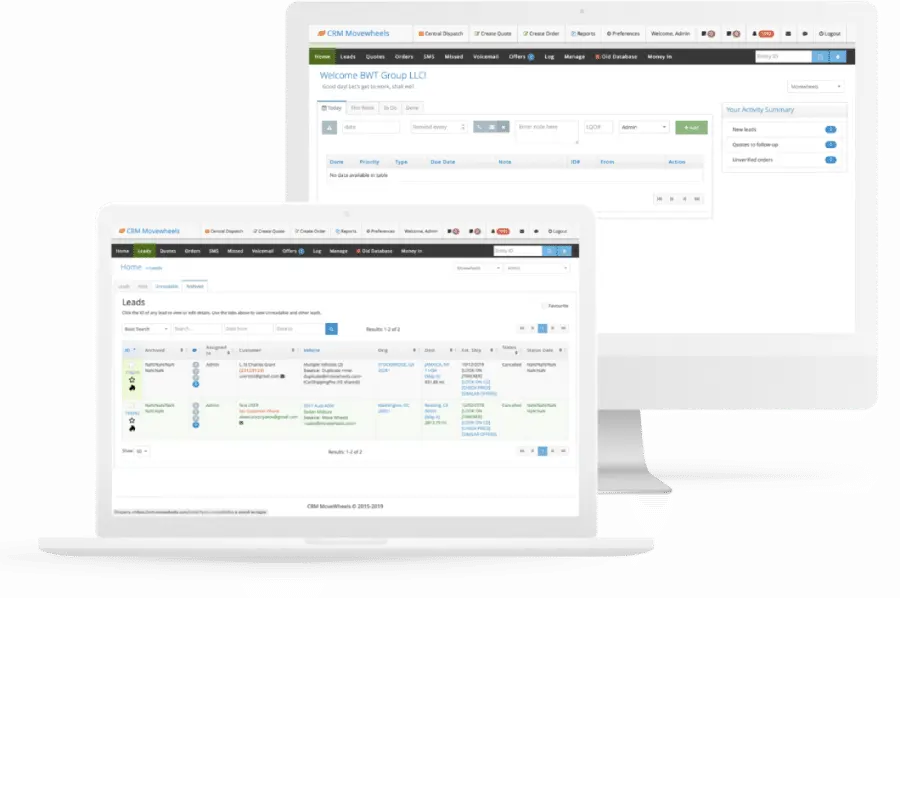
Movewheels (GetCarrier) ships cars across the US. We built a CRM with automated quoting, call workflows, campaigns and analytics. It connects to Central Dispatch and uShip for posting loads, finding carriers, market rates and status. It takes payments through Authorize.Net, Stripe and PayPal, sends contracts through DocuSign, and handles calls and texts through Twilio and Bandwidth.
View case study →A carrier needed to book loads on a large shipper's load board the moment they appeared. The board had no API. We built a bot that works through a secure browser session, watches for matching loads and books them automatically. The shipper is not named, by agreement.
Engagement
It doesn't have to start big.
A first release or one module, with a fixed plan.
For a TMS that gets new features every month.
Our developers join your in-house team on a system you already run.

CLIENT REVIEWS
“Attract Group delivered a high-quality product on a tight deadline. They continue to impress with their knowledge on all things related to development. They're very professional and easy to communicate with.”
“I'm most impressed with Attract Group's commitment. The work meets our expectations, and the new app offers great flexibility for future improvements and better customer service.”
“We know our project is complicated because we need to integrate and make different systems work. The work meets our expectations, and we haven't identified any data gaps.”
01–03 / 03 CURATED · 39 TOTAL ON CLUTCH
FAQ
A first release usually takes a few months. Integrations and data migration affect the timeline most. We give you a date after discovery, not before.
It depends on modules, integrations, migration and user roles. Tools around an existing TMS cost much less than a full build. You get a written estimate after discovery.
Yes, if it has an API or can export data. This is often the cheaper path, and we'll tell you if it's enough.
In most cases, yes. We've connected load boards such as Central Dispatch and uShip, carrier APIs such as XPO and EasyPost, and payment providers. We check each provider's access rules during discovery. Where there's no API, a browser-based connection is often possible.
The TMS should create the charges, because it knows the load. Accounting should own the books. We connect the two so each charge is created once.
Accessorials are added to the load with a reason and an approval. Rebills update both the customer invoice and the carrier bill, with a record of what changed.
Most clients choose the cloud, because there are no servers to maintain. If your policy needs your own servers, we deploy there.
You own the code and documentation, and the system uses common technologies. Another team can pick it up. We also offer long-term support.
Ask how they test billing rules, how they cut over without stopping operations, and what happens when an integration fails at 6 a.m. on a Monday.
Walk us through one load, from quote to payment. We'll show you which steps can be automated, and whether you need a new TMS or better tools around the one you have.